
Yongyeonsa Temple (Daegu) (용연사(대구))
18.6Km 2024-02-15
260 Yongyeonsa-gil, Okpo-eup, Dalseong-gun, Daegu
The name Yongyeonsa has its roots in a legend: a dragon is said to have ascended from the pond at the temple's entrance, leading to the name Yongyeon ("yong" means "dragon" and "yeon" means "pond" in Korean). This temple is renowned as one of the sites that enshrine the Buddha's sarira (relics). Inside Yongyeonsa, the ordination platform holds special significance as the resting place of the Buddha's sarira, where rituals are conducted. This symbolizes the enduring presence of the Buddha. The approach to Yongyeonsa Temple is through a forest-rich path, offering an experience akin to a forest bathing. This path also doubles as a hiking trail leading up to Biseulsan Mountain.
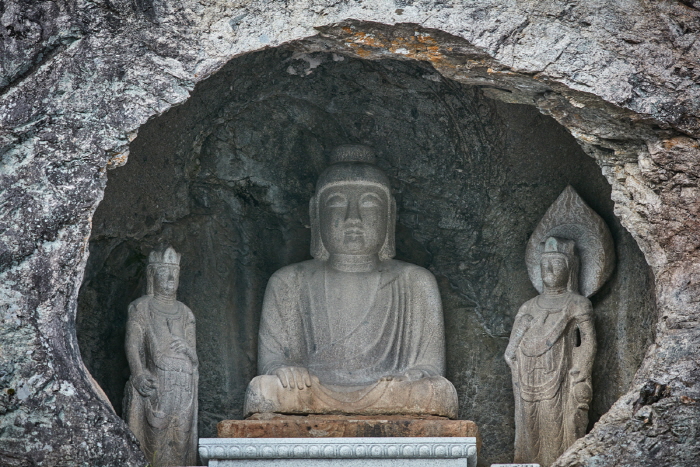
Gunwi Buddha Triad Grotto (2nd Seokguram) (군위 아미타여래삼존 석굴)
19.4Km 2021-11-12
24, Namsan 4-gil, Gunwi-gun, Gyeongsangbuk-do
+82-54-383-8032
At the Hantijae Peak of Palgongsan Mountain in Daegu, is the Gunwi Buddha Triad Grotto, referred to as "the 2nd Seokguram Grotto". This grotto, designated as a National Treasure, is a natural cave on a sheer cliff. There is the beautiful Amitabul Buddha, the Bodhisattva of Power and the Bodhisattva of Compassion. The cave is 4.25 meters wide and 4.3 meters long, and is located 20 meters above the ground. This grotto is the progenitor of the Gyeongju Seokgulam Grotto, preceding the construction of Seokguram grotto by 100 years. It has been designated as a world cultural heritage.
The square-shaped ceiling is highest in the middle of the chamber. The Amitabul Buddha sits in the center with the Bodhisattva of Power and the Bodhisattva of Compassion flanking its left and right sides. The main Buddha is very refined and graceful with short hair and a divine smile on its face, sitting with crossed legs in a full-lotus posture.
Gunwi-gun Palgongsan National Park (팔공산국립공원(군위군))
19.6Km 2025-04-08
Namsan-ri, Gunwi-gun, Gyeongsangbuk-do
+82-54-880-8300
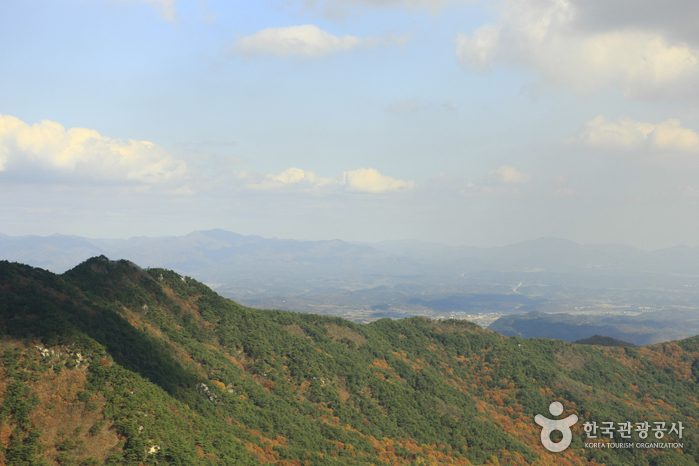
Palgongsan Mountain is located south of the Taebaek Mountain Range where the Nakdonggang and Geumhogang Rivers meet. The mountain stands high and stretches out like a folding screen. Near the top of the mountain, the granite protrudes in an odd shape creating a tall, grand geographical feature of the mountain. Furthermore, every valley is decorated with an exquisite rock face and lush forest adding to the mountain's reputation. Palgongsan Mountain was designated as a National Park in December 2023. The mountain has many ancient temples and historical sites such as the Gatbawi Stone Buddha, Wonhyosa Temple, Cheonseongsa Temple and Bulgulsa Temple.
Chilgok Gasansanseong Fortress and Gasanbawi Rock (칠곡 가산산성 및 가산바위)
19.6Km 2025-01-08
Gasan-ri, Chilgok-gun, Gyeongsangbuk-do
+82-54-979-6452
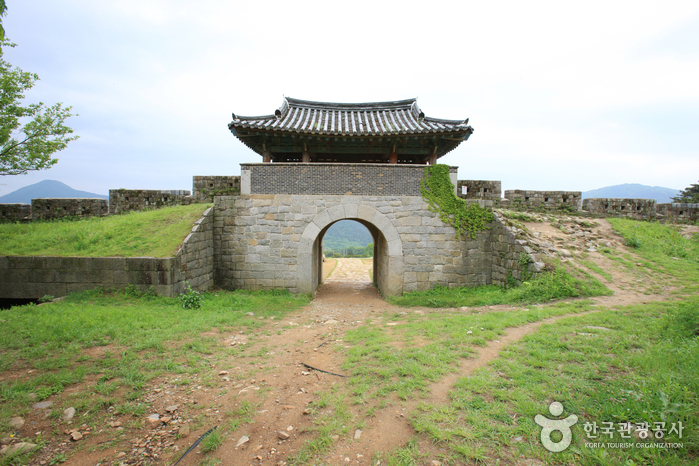
Gasansanseong Fortress in Chilgok-gun, Gyeongsangbuk-do is located in the middle of Chilgok-gun, between Daegu Metropolitan City and Gumi. Gasansan Mountain (901m in elevation) is 10 kilometers west of Palgongsan Mountain. Because it boasts seven peaks, the mountain was called Chilbongsan Mountain. After enduring foreign invasions, including the Imjin War (1592-1598) and the Qing invasion of Joseon (1636), the Joseon rulers built a fortress over the course of 100 years to aid in Korea’s defense. It is Korea’s only three-layered fortress, consisting of inner, outer and central walls. The flat Gasanbawi Rock at the mountain’s peak, which is large enough to accommodate 100 people at a time, offers a great view of Daegu Metropolitan City.
 English
 한국어
한국어 日本語
日本語 中文(简体)
 Deutsch
 Français
 Español
 Русский


