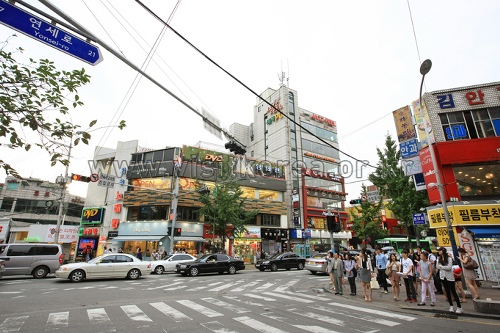
Yeonsero (Yonsei University Street) (연세로)
2022-10-25
Area of Yeonse-ro, Sedaemun-gu, Seoul
This road takes you from Sinchon Subway Station right to Yonsei University. Like branching tree roots, the numerous side streets diverge off the main road. In 1999 Yonsei College Street was designated as “The Road One Wants to Walk.” Since then, this famous street has been improved upon even more, placed on tourist maps and promoted by businesses. A visitor to this area can eat at a plethora of restaurants, coffee shops and stores. In the afternoon hours, you can also enjoy the taste of small food stands that line the sidewalks.
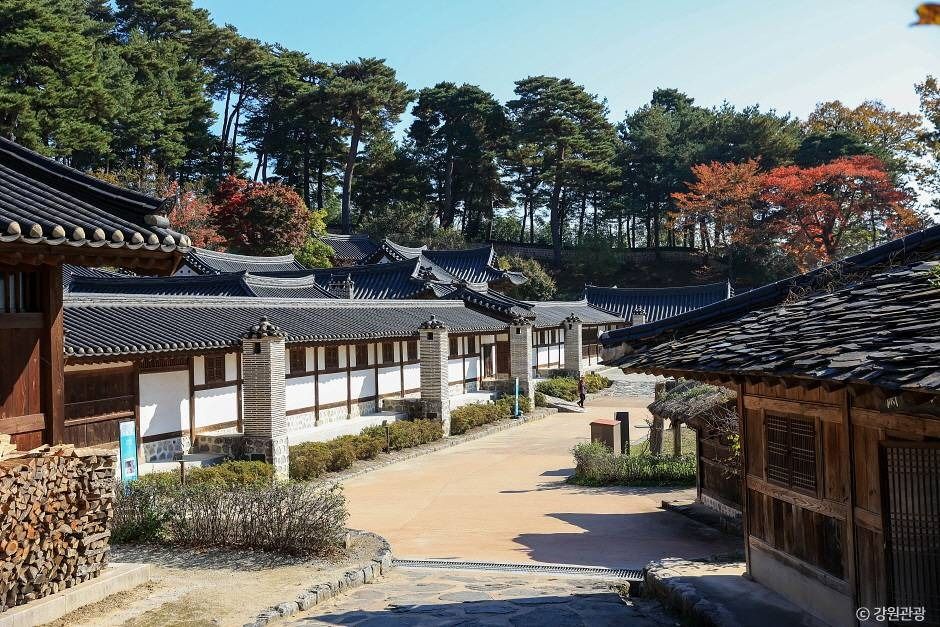
Seongyojang House (강릉 선교장)
2025-12-15
63, Unjeong-gil, Gangneung-si, Gangwon-do
Seongyojang House is the former upper class residence of Lee Nae-beon (1703-1781) and his family in Gangneung, Gangwon State. It was designated as a National Folklore Cultural Heritage in 1967. The one-syllable word "Seon" in Seongyojang means boat. Gyeongpoho Lake was right in front of Seongyojang House at the time it was built, thus making is accessible by boat.
Seongyojang House has all the features of a typical upper class residence during the Joseon period. The complex even has a large pond with a pavilion named Hwallaejeong Pavilion. While the building still blends beautifully with the surrounding nature, Seongyojang House has been well-preserved and is considered a valuable resource in the historical research of living conditions of upper class households during the Joseon dynasty.
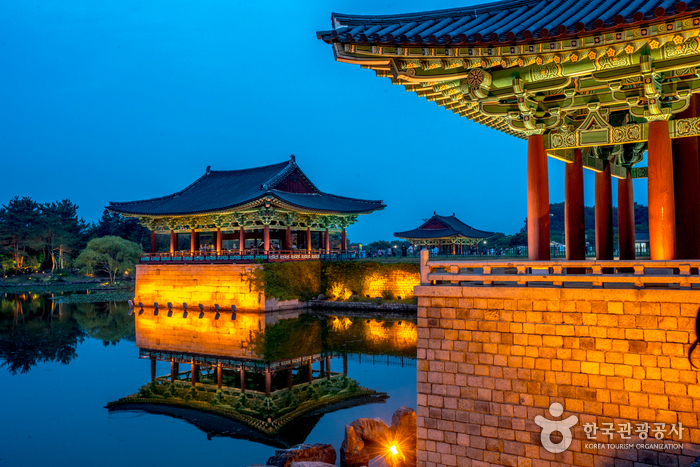
Donggung Palace and Wolji Pond (경주 동궁과 월지)
2026-05-27
102 Wonhwa-ro, Gyeongju-si, Gyeongsangbuk-do
Donggung Palace and Wolji Pond in Gyeongju are secondary palace sites of Silla. The palace, along with other secondary palaces, was used as the eastern palace where the prince lived, and banquets were held during auspicious events or to welcome important guests. It is also where King Gyeongsun of Silla invited King Wang Geon of Goryeo and had a feast to complain about the critical situation in 931 after being invaded by Gyeon Hwon. After unifying the three kingdoms, Silla's King Munmu dug a large pond in the 14th year of his reign (674), creating three islands in the center of the pond along with a 12-peaked mountain to the northeast. Beautiful flowers and trees were planted here, and rare birds and animals were raised. In the Samguksagi (History of the Three Kingdoms) from the Goryeo dynasty, there is only a record of Imhaejeon Hall and no mention of Anapji Pond. After Silla fell and the place fell into ruins during the Goryeo and Joseon dynasties, poets and calligraphers looked at the pond and recited a line of poetry that says, “The once splendid palace is gone, and only geese and ducks fly in.” That's why the place is called Anapji, using the letters 'an' for wild geese and 'ab' for ducks. In the 1980s, pottery fragments with the inscription "Wolji" were excavated, and it was confirmed that this area was originally called "Wolji," which means "a pond that reflects the moon." And the name Anapji was changed to Wolji Pond afterwards.◎ Travel information to meet Hallyu’s charm - "The Beauty Inside"Se-gye visits this place to refresh her mind after she argues with Do-jae over the contract. Being one of the most famous tourist sites in Gyeongju, the scenery here is enough to help you forget the argument that you’ve just had, especially at night.
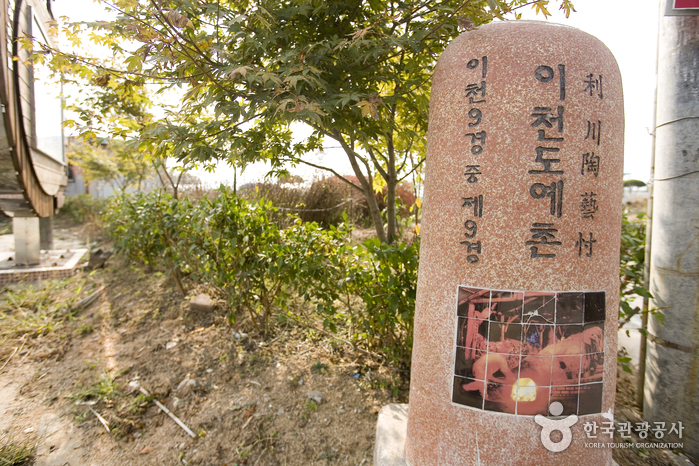
Icheon Ceramics Village (이천도예마을)
2023-04-06
19, Gyeongchung-daero 3150beon-gil, Icheon-si, Gyeonggi-do
Icheon Ceramics Village produces traditional Korean ceramics, which are of high quality. The village became the center of traditional pottery during the Joseon dynasty (1392-1910) for about 500 years due to the easily obtainable materials in the areas. Icheon Ceramics Village was also the center of Joseon Baekja ceramics. Presently, about 80 pottery factories are congregated at the village, and about 300 pottery kilns are in use.
Visitors can observe the pottery production process, and purchase them directly. It is worthwhile to see the crafts of these potters known as Living Cultural Treasures of Korea for creating the highest quality handicrafts. Not only are the traditional Cheongja, Baekja, and Buncheong pottery produced here, but you can also view modern design pottery. The Haegang Ceramics Art Center is the only ceramics Art Center in Korea, where you can learn about ceramics. One of the must-see events at Icheon Ceramics Village is the internationally famous “Icheon Ceramics Festival” held every year. Displayed pottery as well as, pottery classes, traditional kiln handling, pottery character show, and even parades are held.
![Namhansanseong Provincial Park [UNESCO World Heritage] (남한산성도립공원 [유네스코 세계문화유산])](http://tong.visitkorea.or.kr/cms/resource/56/2612856_image2_1.jpg)
Namhansanseong Provincial Park [UNESCO World Heritage] (남한산성도립공원 [유네스코 세계문화유산])
2024-02-29
731 Namhansanseong-ro, Namhansanseong-myeon, Gwangju-si, Gyeonggi-do
Namhansanseong was a fortress that protected the southern approaches to the capital during the Baekje kingdom (18 B.C. – 660 A.D.) and the Joseon dynasty (1392-1897). During the Qing invasion of Joseon in 1636, King Injo of Joseon (reigned 1623-1649) sought refuge here and constructed Haenggung, a temporary palace. Subsequently, it became the administrative center of the Gwangju region, and today, it is a site where many cultural properties are preserved.

Amnam Park (부산 암남공원)
2023-01-11
185, Amnamgongwon-ro, Seo-gu, Busan
The magnificent cliffs and tree-lined seaside views of Amnam Park bring the harmony of the bluish-green waters and the forested landscape together. Originally a protected area, entrance was not permitted until its opening to the public in 1996, when visitors could first experience the untouched landscape. Now, visitors can fish, explore the observatory, and enjoy the walking path and the elevated bridge. The abundunt pine trees along the walking path make for a pleasant stroll while the path up to the observatory offers great views. If it is fishing that you want, here you can fish on the ocean as well as off the fantastically shaped rocks. There is also a famous road to go for a drive, leading from Songdo Beach to Amnam Park. This drive takes approximately 5 minutes, but it takes about 20 minutes on foot.
Chodang Dubu Village (초당두부마을)
2022-12-23
89-8 , Chodangsundubu-gil, Gangneung-si, Gangwon-do
Just south of Gyeongpo Beach is Chodang Dubu Village, which is famous for dubu (tofu). Chodang dubu is made from ground beans and salt water from the East Sea resulting in a soft and light tofu. The name of this village, Chodang, originates from the name of a famous family that once lived here known as Chodang Heoyeop. Heoyeop was the father of son, writer/poet Heo Gyun (1569~1618) and daughter, poet Heonan-seolheon (1563~1589). A traditional-style Korean house has been reconstructed on the site where the original house of Heo Gyun and Heonan Seolheon once stood.
Gameunsaji Temple Site (경주 감은사지)
2025-06-12
Yongdang-ri, Gyeonju-si, Gyeongsangbuk-do
Gameunsaji Temple Site was built by King Munmu (AD 661-681), the king of Silla who unified Baekje and Goguryeo in the late 7th century. The purpose of the temple site was to pray for help and guidance from Buddha against Japanese invasion. Unfortunately, King Munmu passed away before the completion of the temple, and left a will to be cremated and buried in the East Sea so that he may reincarnate as a sea dragon in order to protect the country. As he wished, King Munmu's ashes were scattered at Daewangam of the East Sea. The temple was completed and was named by his son, King Sinmun (AD 681-692) in respect and appreciation for his father.
Gameunsaji Temple Site was rebuilt in 1979 based on the discovery of the site's foundation after two years of archeological research. The three-story stone pagoda at the temple site is a reminent of the early period of unified Silla, assembled with several parts which rise up to 13.4m high, known to be Silla's highest three-story pagoda.
Gyeongpodae Pavilion (강릉 경포대)
2025-01-16
365 Gyeongpo-ro, Gangneung-si, Gangwon-do
Gyeongpodae Pavilion, located on a small hill north of Gyeongpoho Lake, is one of the eight scenic sites of Gwangdong (northeastern coast). The pavilion was originally built in another location in 1326 but was moved to its current location in 1508. The pavilion shape and design changed over time before settling on the current design. The pavilion has five pillars in the front and on the side, with a gabled roof line, a common design in Korean architecture.
The inside of Gyeongpodae Pavilion is decorated with calligraphy and poems written by many famous scholars of the Joseon dynasty, including both King Sukjong and Yulgok Yi I. The pavilion is surrounded by a pine tree forest, and is famous for its view of the moon reflecting off the waters of the lake below, which gave the pavilion its name. The area around the pavilion was designated as a provincial park in 1981.
Phoenix Park (휘닉스 평창)
2024-02-08
174 Taegi-ro, Bongpyeong-myeon, Pyeongchang-gun, Gangwon-do
Phoenix Park offers a year-round Pyeongchang experience, set on a pristine plateau 700 meters above sea level. This multifaceted resort is equipped with an array of recreational and leisure amenities, including the Phoenix Snow Park, cozy hotel accommodations, condominiums, the Phoenix Country Club, and the aquatic thrills of Blue Canyon. The condominiums serve as a convenient hub, providing a variety of facilities under one roof. Notably, the main condo complex, featuring the blue, green, and orange buildings, is acclaimed for its architectural fusion of Eastern and Western design elements. Phoenix Park was chosen as a snow sports venue for the 2018 Winter Games and served both as the Phoenix Snow Stadium and a pivotal support facility for the events.
 English
 한국어
한국어 日本語
日本語 中文(简体)
 Deutsch
 Français
 Español
 Русский


