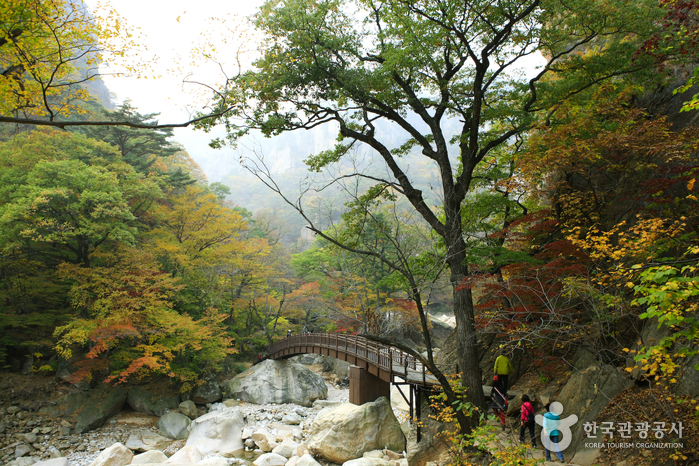
Seoraksan National Park (Southern Section) (설악산국립공원 (남설악))
2024-04-02
801 Seorak-ro, Yangyang-gun, Gangwon-do
Seoraksan Mountain, the highest amid the Taebaek Mountain Range, boasts beautiful landscape and scenery all year round. To the east of Hangyeryeong and Misiryeong Passes is classified as the outer section ("Oeseorak"), to the west is the inner section ("Naeseorak"); and to the south of Hangyeryeong Pass as the southern section ("Namseorak").
The southern section is famous for its mineral water, hot springs, and waterfalls including Yongsopokpo, Sibipokpo, and Yeosinpokpo Falls. Jeongbongsan Mountain (1,424.2 meters) is also included in the area. There are also several different hiking courses varying in distance and duration.
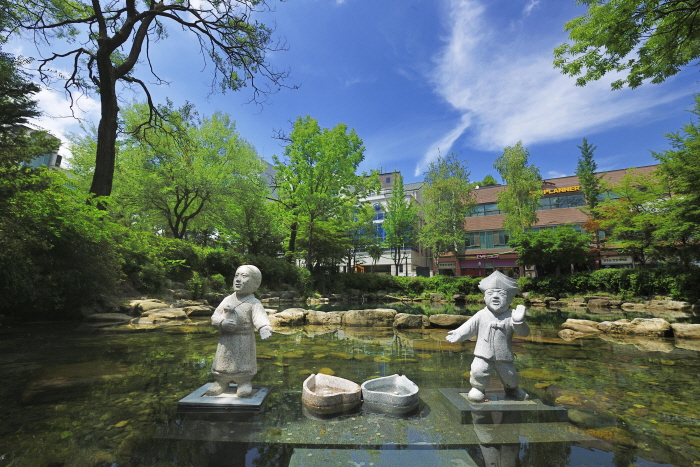
Hwangji Pond (황지연못)
2024-12-23
12 Hwangjiyeonmot-gil, Taebaek-si, Gangwon-do
Hwangji Pond, located in downtown Taebaek, is a source of the Nakdonggang River, flowing all the way to the Yeongnam Plain. The pond is divided into three sections: Sangji, with a diameter of 100 meters, Jungji and Haji. Although it is small in size, the pond supplies 5,000 tons of water a day.
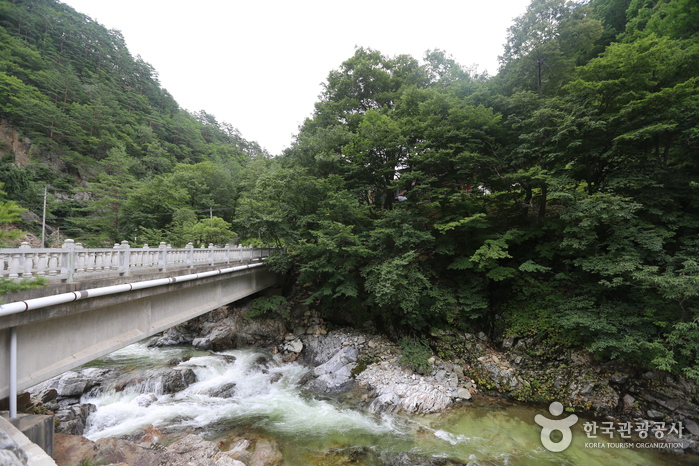
Micheongolgyegok Valley (미천골계곡)
2019-11-09
Guryongnyeong-ro, Seo-myeon, Yangyang-gun, Gangwon-do
+82-33-670-2397
Micheongolgyegok Valley starts from the Yangyang area and ends right before Guryongnyeong Pass. With not many visitors here, the valley is left in a pristine condition. The area is famous for its rich forest, clean water, uniquely shaped rocks, wild flora and fauna, underground mineral water, cultural heritages of the ancient SIlla kingdom, locally produced honey and other forest products. The Micheongolgyegok Valley Recreational Forest is 5,652,000㎡ in size filled with broadleaf trees. At the entrance of the valley is Seollimwon Temple Site, which was originally established under the reign of King Beopheung of Silla and then closed at the end of the Goryeo dynasty. Other relics include a stone lamp, 3-story stone pagoda, Honggakseonsa Monk Pagoda, and a stupa.

Saeyeongyo Bridge (Saeseom Island) (새섬 새연교)
2026-06-10
40 Namseongjung-ro, Seogwipo-si, Jeju-do
Saeyeongyo Bridge connects Seogwipo Port to the uninhabited Saeseom Island. Its name means "a bridge creating new relationships." The walking path features musical benches and is renowned for its sunset and night views. There is a beautiful musical fountain show twice a day. It's a pleasant walk from Cheonjiyeonpokpo Falls, crossing the Saeyeongyo Bridge to Saeseom Island.
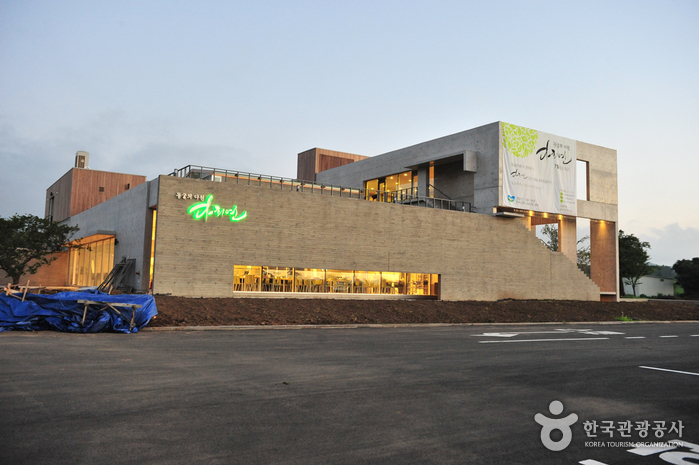
Daheeyeon Garden (다희연)
2019-12-20
117, Seongyo-ro, Jeju-si, Jeju-do
+82-64-782-0005
Daheeyeon Garden is a major tea farm on Jeju Island, which has the best conditions for growing great tea in a natural environment. Jeju has a year-round average temerature of 16℃ and nutrient-rich soil with plenty of water for the tea plants to grow well. The two cave cafes, Evergreen Luce Garden and Eve Hall, serve naturally fermented green tea bread, cookies, muffins, green tea latte and green tea juice.
Evergreen Luce outdoor garden was built inside a cave formed naturally by a volcanic eruption. Despite being in a cave, this outdoor garden has ponds, bridges, indigenous trees and flowers. Eve Hall is located through a hole in the cave ceiling and can be only reached after passing through a tunnel-like cave. The deepest part of Eve Hall is roughly 30 meters and is home to bats; if you are lucky, you might even see a few.
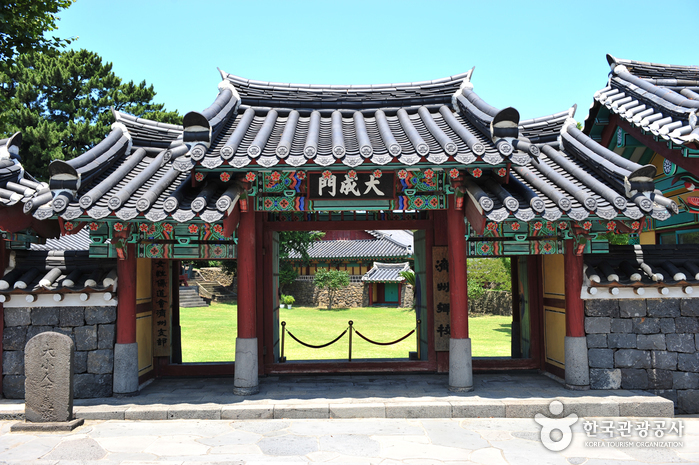
Jejuhyanggyo Confucian School (제주향교)
2020-02-18
43, Seomun-ro, Jeju-si, Jeju-do
+82-64-757-0976
Jejuhyanggyo Confucian School is an educational center that teaches Confucianism to local people, and holds ancestral ceremonies for the great Confucian scholars. It is also used as an administration office, and a gathering place for the local Confucians. It has two main halls: Myeongnyundang and Daeseongjeon, which houses ancestral tablets.
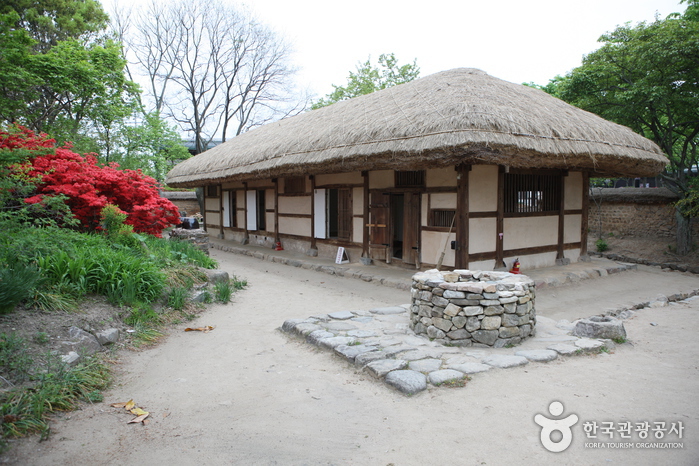
Sin Jae-hyo's House (고창 신재효 고택)
2024-04-07
100, Dongni-ro, Gochang-gun, Jeonbuk-do
Sin Jae-hyo (1812-1884) was a legendary theorist, director, and sponsor of pansori (epic chant). Sin Jae-hyo's House in Gochang was built in 1850, and visitors can observe sarangchae (main room), an old well, and a paulownia tree preserved to this day. Sin was not a singer himself but a pansori enthusiast, and he used wealth to train potential singers and contribute to the growth of pansori. He also compiled and edited six pansori madangs (operas) titled Ttoggi Taryeong, Bak Taryeong, Simcheongga, Jeokbyeokga, Chunhyangga, and Garujigi Taryeong, of which only five are passed down. To honor his contributions and passion for pansori, Dongni Gugakdang was founded behind this house.
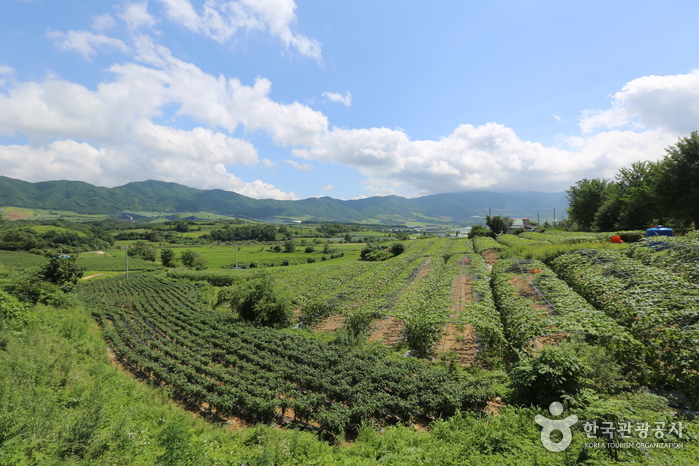
Yanggu Punch Bowl Village (양구 펀치볼마을 (펀치볼))
2020-08-31
50-3, Dongmakdong-gil, Yanggu-gun, Gangwon-do
+82-33-481-2648
Punch Bowl is a highland basin situated 400-500 meters above sea level in Yanggu-gun, Gangwon-do. The name comes from the basin's resemblance to a large punch bowl. The village has around 1,700 residents, and is the only town that is located inside the Civilian Access Control Line. Along with the nearby Daeamsan Mountain, Punch Bowl was once a ferocious battlefield during the Korean War. Several monuments were erected in memory of the deceased souls. Since the war, civilian access has been limited, allowing the natural environment in the area to recover. Rare flora and fauna reside in the area, and on top of Daeamsan Mountain is Yongneup Swamp (Natural Monument No. 246), Korea's one and only high moor and time-honored treasure trove for the ecosystem.

Yeonggeumjeong (영금정)
2022-12-21
35, Dongmyeonghang-gil, Sokcho-si, Gangwon-do
Yeonggeumjeong refers to the area covering the shore by the Sokcho Lighthouse in Sokcho-si City. The name Yeonggeumjeong comes from a notion that the sound of waves hitting the rocks is comparable to the melody of geomungo (traditional stringed instrument with 6 strings). At the end of the 50m-long bridge built over a rocky peninsula is a pavilion offering a view of the East Sea.
Buan Guam-ri Dolmens (부안 구암리 지석묘군)
2024-04-07
Seoksang-ri, Buan-gun, Jeonbuk-do
Buan Guam-ri Dolmens, designated as Historical Site No. 103, is comprised of southern-style dolmens. Dolmen refers to a particular structure of a tomb created during the Bronze Age. Dolmen is largely classified into two groups – Southern-type that has small footstones supporting large top stone; and Northern-type which is shaped like a desk. In Guam-ri, there were originally 13 dolmens, but only 10 remain. Most of the dolmens have 8 small footstones propping up one large top stone, compared to the dolmens in other regions which normally have 4 footstones.
 English
 한국어
한국어 日本語
日本語 中文(简体)
 Deutsch
 Français
 Español
 Русский


