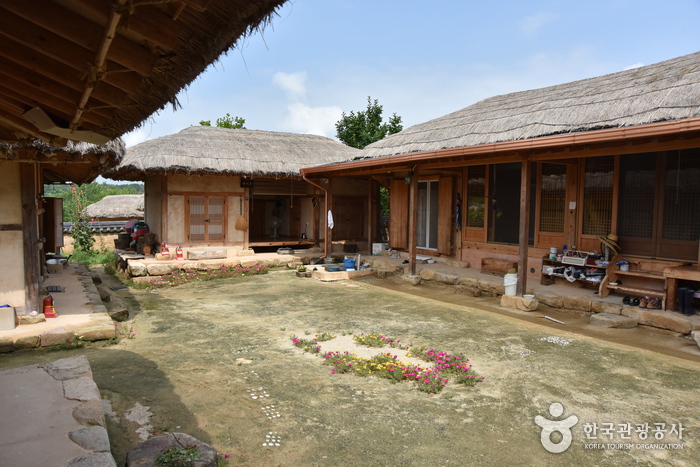
Ga Gyeong Jae (가경재)
18.4Km 2024-12-20
69-5 , Hahoenamchon-gil, Andong-si, Gyeongsangbuk-do
Gagyeongjae is a thatched hanok on the edge of Hahoe Folk Village in Andong, Gyeongsangbuk-do. There are five guestrooms altogether. The main house or Anchae has a wooden porch while the Sarangchae (men’s house) shares a central living space. Windows are lined in the traditional way with hanji paper, and opening them lets in a cooling breeze and reveals the beautiful surrounding landscape. The wood-fired Red Clay sauna room is very popular, but visitors need to make a reservation at least two days in advance to get the furnace started. Rooms have AC installed (additional fees in summer).
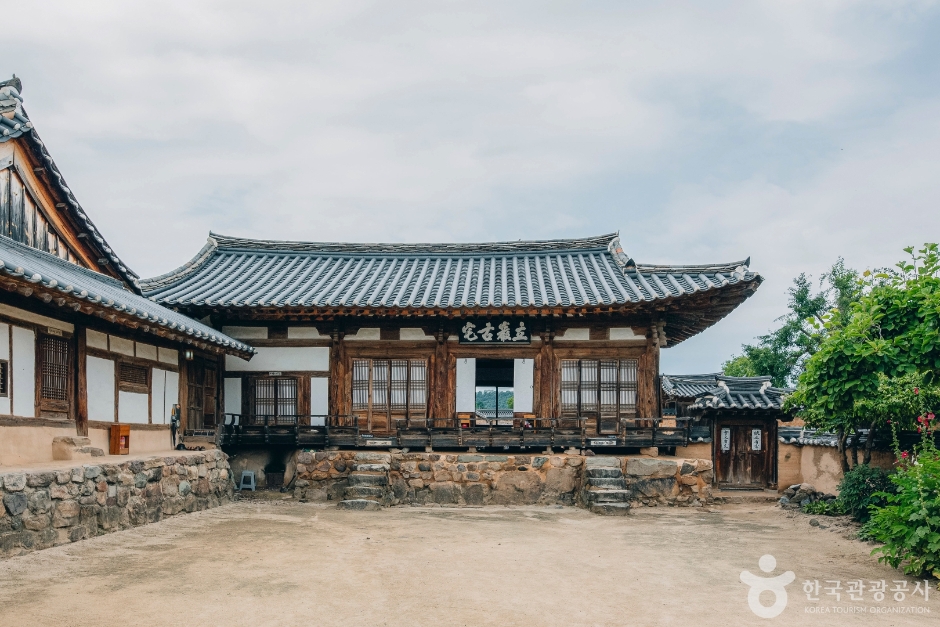
Yangjindang/ 하회 양진당
18.4Km 2025-03-05
68 , Hahoejongga-gil, Andong-si, Gyeongsangbuk-do
Hahoe Yangjindang, in Hahoe Village in Andong, Gyeongsangbuk-do, is the head house of the Ryu Clan of Pungsan. Also known as Ipam Old House, it’s a designated national cultural treasure. An unusual feature is the incorporation of two different architectural styles: the sarangchae is in the Goryeo style, while the anchae is in the Joseon style. The rooms are simple and elegant, with antique mother-of-pearl cupboards, tableware cabinets, and ceramics placed here and there add to the old-time charm. Guests can enjoy traditional folk games, or have a go at home-brewing or making rice cakes and sweets.
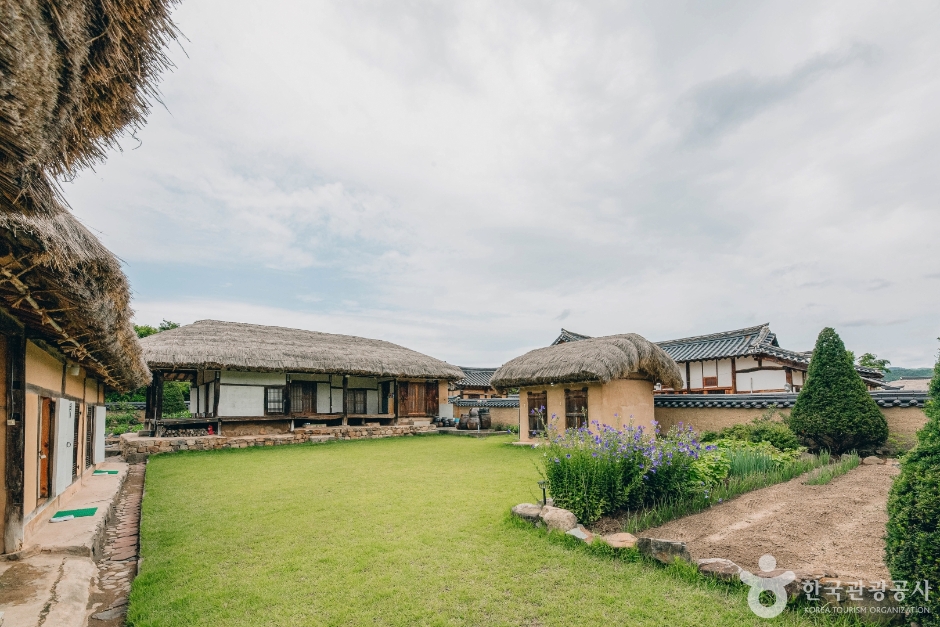
Garam Choyeonjae (가람초연재)
18.4Km 2024-08-01
76-6 , Hahoejongga-gil, Andong-si, Gyeongsangbuk-do
Garam Choyeonjae stands within Hahoe Traditional Village in a loop of the beautiful Nakdonggang River in Andong, Gyeongsangbuk-do. Among Hahoe’s tile-roofed old houses, this one’s thatched roof stands out. ‘Garam’ was the pen name of the owner’s grandfather - a descendant of the Joseon scholar Seoae Ryu Seong-ryong - while ‘Choyeonjae’ means a thatched house where swallows live. The swallows’ nest is still there under the eaves, and sunset views from the wooden terrace of the sarangchae (men’s house) are a dreamy experience. Visitors can also learn about traditional technologies such as treadmills and millstones.

Damyeonjae (담연재)
18.5Km 2023-07-10
76-3 , Hahoejongga-gil, Andong-si, Gyeongsangbuk-do
Damyeonjae is a hanok accommodation located in Hahoe Village, Andong. It was built in the 1980s but faithfully implemented the appearance of a traditional hanok. The chimney rising behind the yard and the tiles which line the roof are excellent enough to be considered a cultural asset, and the wood used for the beams and the cheongmaru is also very luxurious. Uniquely, it was built in a 'c' shape with the gate and haengnangchae moved to the edge of the yard, rather than a square shape like the traditional hanok in the Gyeongsang region. Thanks to the open view to the south, the entire Andong Hahoe Village and Hwasan Mountain can be viewed from the yard. Damyeonjae is the home of Korean actor Ryu Si-won, and his is known to have spent his childhood here. In 1999, Queen Elizabeth II of England experienced Korean culture and received a 73rd birthday award here, making it even more famous. Damyeonjae is currently operated as a hanok stay where only one group can stay each day. The kitchen and bathroom are modernly decorated to add convenience.
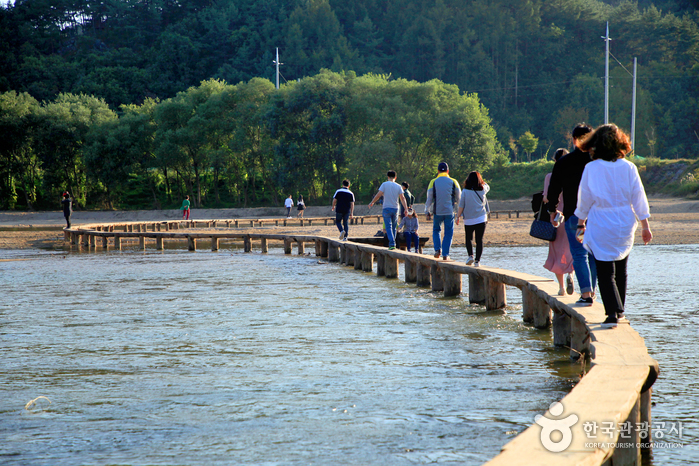
Yeongju Museom Village (영주 무섬마을)
19.4Km 2021-08-24
31-12, Museom-ro 234beon-gil, Yeongju-si, Gyeongsangbuk-do
Located in Sudo-ri in Yeongju, Gyeongsangbuk-do, Museom Village is a charming hanok village surrounded by water. Flowing down from Sobaeksan Mountain and Taebaeksan Mountain, Naeseongcheon Stream and Yeongjucheon Stream converge and loop around Museom Village, surrounding the village on three sides with water. This peninsula-like village is not only the center of traditional Korean culture, but also has a gorgeous natural landscape complete with a wide sandy riverside and a lush inland forest.
Known for Haeudang and Manjukje Houses (two of the most historical hanok houses in the area), the village is also home to other outstanding traditional houses such as the Kim Gyu-jin House and the Kim Wi-jin House. Manjukje House is located at the heart of the village and the oldest traditional house in this hanok village. Manjukje was built in 1666 (7th year of King Heonjong's reign) by Bak Su (the father of the Bannam Bak Family).
Nearby Manjukje is Manun House, built in the early 19th century and named after Kim Hwi-geol (penname “Manun”). The house later became the home of the wife of the famous poet Jo Ji-hun, author of “Byeolli,” a poem expressing the beauty of Museom Village.
Other notable houses include the Kim Wi-jin House (a house belonging to aristocrats), the Kim Jeong-gyu House (a house without the traditional outer fencing), and the Bak Jae-yeon House, where the writings of Bak Gyu-su (a respected scholar during the Joseon period) still remain today.
Another famous attraction in the village is the Single Log Bridge, which was the village’s only connection to the outside world for over 350 years before the construction of Sudo Bridge in 1979. It is a tiny bridge in terms of x_width (30 cm), but it stretches for over 150 meters. It is said that the bridge was rebuilt annually after being destroyed each rainy season. With the construction of Sudo Bridge, the Single Log Bridge was no longer needed, but was rebuilt some time later in its original form. To celebrate the bridge’s impressive history, the village hosts the Single-Log Bridge Festival every October.
![Manjukjae House[Korea Quality] / 만죽재 고택[한국관광 품질인증]](http://tong.visitkorea.or.kr/cms/resource/55/3016955_image2_1.jpg)
Manjukjae House[Korea Quality] / 만죽재 고택[한국관광 품질인증]
19.5Km 2024-10-30
11-10 , Museom-ro 234beon-gil, Yeongju-si, Gyeongsangbuk-do
Manjukjae House is the oldest hanok in Museom Village, Yeongju, Gyeongsangbuk-do, with a history dating back 360 years. Originally built by Park Su to live the life of a reclusive gentleman after the Manchu Invasion of Korea, the house has been passed down from generation to generation through 13 generations. There are four guest rooms, Seomgye Chodang, Sarangchae (detached building), Anchae (main building), and Chaekbang (study), all of which can accommodate two people. Among them, Seomgye Chodang offers the best view, from where guests can enjoy the scenery of the log bridge in Museom Village, the Naeseongcheon Stream, and the white sandy beach. With the windows wide open, you can enjoy the cool breeze and the soothing sounds of nature.
 English
 한국어
한국어 日本語
日本語 中文(简体)
 Deutsch
 Français
 Español
 Русский


