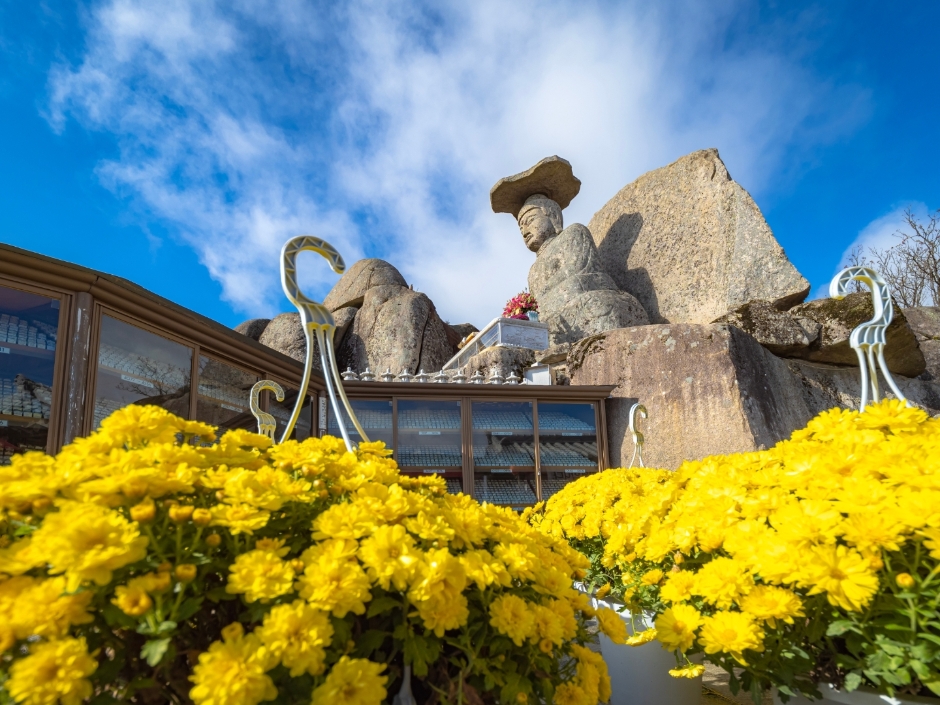
Palgongsan National Park (Gatbawi Section) (팔공산국립공원(갓바위지구))
14.5Km 2025-04-08
716-64 Gatbawi-ro 81-gil, Wachon-myeon, Gyeongsan-si, Gyeongsangbuk-do
Located east of Daegu downtown, Palgongsan Mountain (altitude 1,192.3 meters) was called both Jungaksan and Buaksan Mountain during the Silla period. The mountain has many ancient temples and historical sites such as the Gatbawi Stone Buddha, Wonhyosa Temple, Cheonseongsa Temple and Bulgulsa Temple.
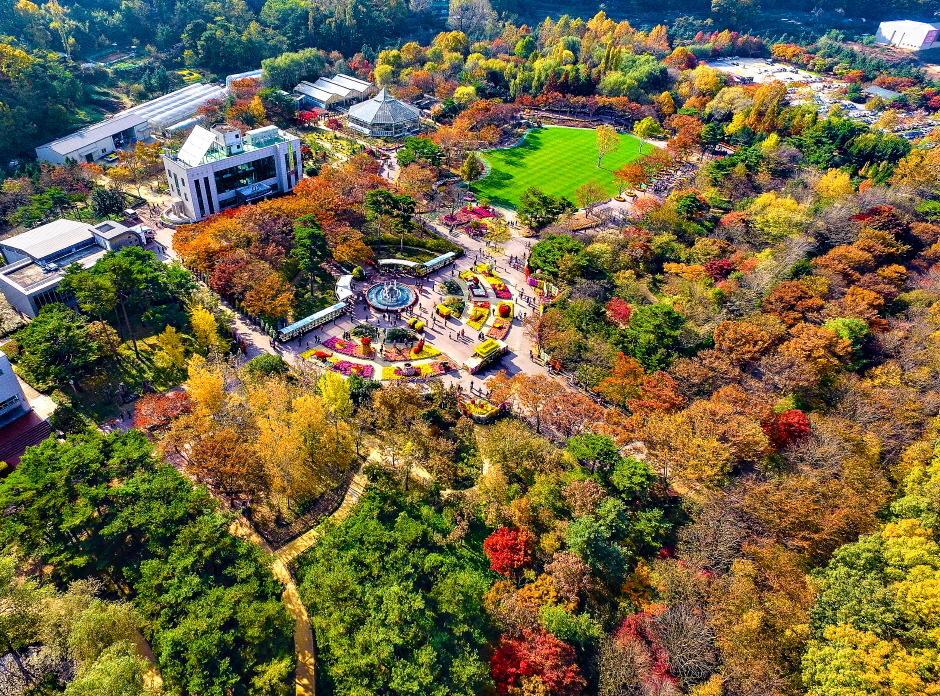
Daegu Arboretum (대구수목원)
14.8Km 2023-11-17
342 Hwaam-ro, Dalseo-gu, Daegu
Daegu Arboretum is located at the site of an old sanitary landfill. The restoration of the area passed through many stages from 1996 until the opening in May 2002. It is home to more than thousands of species of plants including giant cacti, flowers, medicinal herbs, and trees in 21 gardens. The arboretum serves as an ecological education center and rest area for Daegu citizens. Ecology experience programs for students and young children are held regularly during summer vacation. Nearby attractions include Apsan and Duryu Parks, as well as Palgongsan and Biseulsan Mountains.
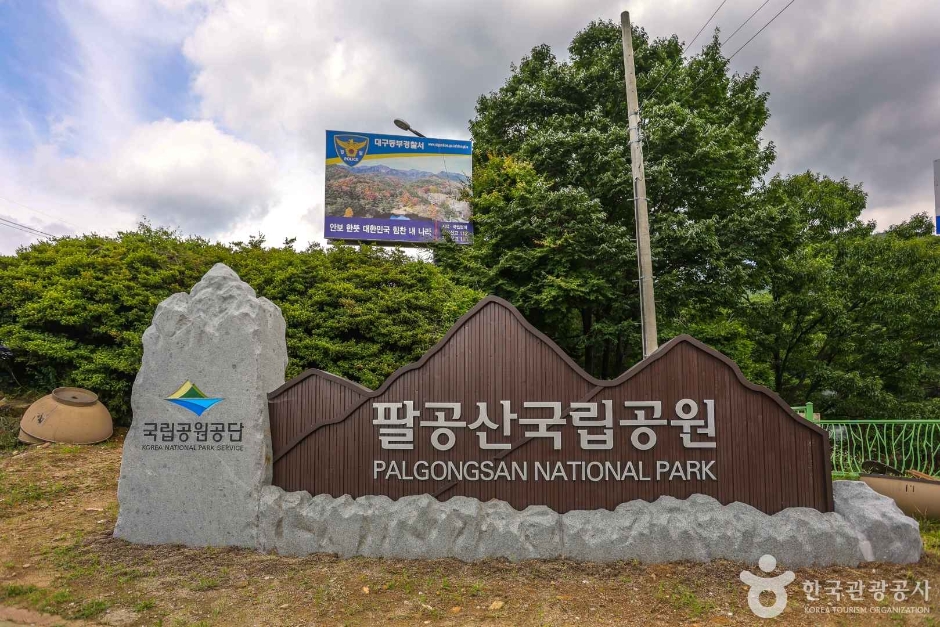
Palgongsan National Park (Pagyesa Temple District) (팔공산국립공원(파계사지구))
14.9Km 2025-04-08
741 Pagye-ro, Dong-gu, Daegu
Palgongsan National Park is located close to Palgongsan Mountain, one of the larger mountains in the Taebaek Mountain Range. Palgongsan Mountain is located 20 kilometers northeast from downtown Daegu, where Nakdonggang River and Geumhogang River meet. The mountain has three peaks in a row: Birobong Peak in the center and Dongbong Peak (aka Mitabong, 1,155 m) and Seobong Peak (aka Samseongbong, 1,150 m) on each side.
The park is within the administrative district of Dong-gu, Daegu and has four towns along its border including Yeongcheon-si, Gyeongsan-si, and Chilgok-gun. A number of Buddhist temples including Donghwasa Temple, the headquarters of the 9th Buddhist Parish, are located in the area.
The park has numerous rocks and valleys and is carpeted with azaleas in the spring. In autumn, many visitors flock to the park to admire the fall foliage on the trees lining the 16.3 kilometer-long roadway that runs through the park. With vibrant green leaves in spring and a delicate snowscape in the winter, Palgongsan Mountain is an attractive destination for visitors throughout the year.
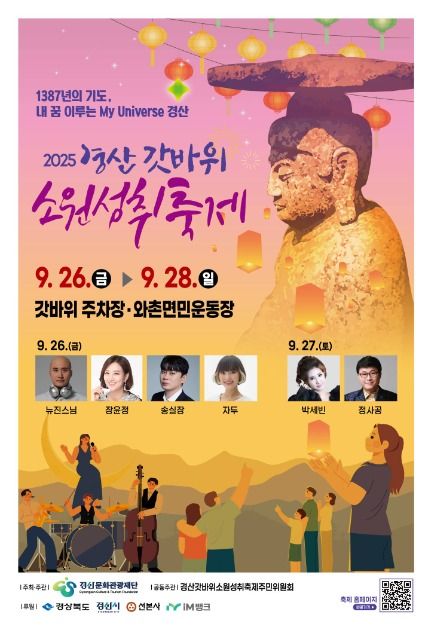
Gyeongsan Gatbawi Wish Fulfillment Festival (경산 갓바위소원성취축제)
15.4Km 2025-10-23
Wachon-myeon, Gyeongsan-si, Gyeongsangbuk-do
+82-53-819-0332
Gyeongsan Gatbawi Wish Fulfillment Festival is a healing and participatory festival that blends traditional culture with modern performances. Various events and hands-on activities are offered during the festival, including tea ceremony programs, temple stay, wish pagoda stacking, meditation, and yoga. Visitors can also explore various regional products such as fresh Wachon plums and enjoy opening performances.

Hayang Life Sports Park (하양생활체육공원)
15.8Km 2024-02-23
33 Yongcheonjebang-gil, Hayang-eup, Gyeongsan-si, Gyeongsangbuk-do
Hayang Life Sports Park was constructed to enhance physical education amenities and offer a relaxation space for residents. It features a football field, futsal court, foot volleyball court, gateball court, and a lawn for relaxation. Additionally, it boasts a floor fountain, a pavilion, a walking trail, and various photo zones. During the summer, a water playground is available. Nearby attractions include Palgongsan Mountain and Daegu Stadium.
Daemyeong Reservoir (대명유수지)
16.0Km 2024-02-15
816 Daecheon-dong, Dalseo-gu, Daegu
Daemyeong Reservoir, located adjacent to Dalseong Marsh, is at the convergence point of the Nakdonggang River, Geumhogang River, Daemyeongcheon Stream, and Jincheon Stream. This area is a rich ecological reserve, home to a diverse range of wildlife including the narrow-mouthed toad, leopard cat, weasel, common kestrel, and water deer, along with various wild plants. Visitors to the area can explore narrow-mouthed toad habitats, observation decks, ecological exploration trails, and photo zones. There's also a narrow-mouthed toad ecological learning center for educational experiences. The surrounding landscape, with its stretches of silver grass and reeds along the walking decks, offers a picturesque setting, particularly attractive for autumn photography.
Keimyung University Dongsan Hospital (계명대학교 동산병원)
16.1Km 2025-10-23
1035 Dalgubeol-daero, Dalseo-gu, Daegu
Established in 1899 as Daegu's first Western medical institution, Keimyung University Dongsan Hospital is a cutting-edge, eco-friendly facility offering 37 specialties. It features top centers for cancer, robotic surgery, cardiocerebrovascular diseases, and organ transplants. In 2023, it won the Medical Korea Award for cancer care. The International Healthcare Center has been providing personalized services to international patients since 1967.
Dalseong Marsh (대구 달성습지)
16.5Km 2025-06-10
88 Gura 1-gil, Hwawon-eup, Dalseong-gun, Daegu
Dalseong Marsh is located in the meeting point of Nakdonggang River, Geumghogang River, Jincheoncheon Stream, and Daemyeongcheon Stream. Spanning an area of 2 ㎢, the marsh comprises wetlands and freshwater lake where various seasonal aquatic plants are grown. It is also home to several different species of migratory birds.
Dalseong Korea-Japan Friendship Center (달성 한일우호관)
16.7Km 2022-12-29
206, Urok-gil, Dalseong-gun, Daegu
The Dalseong Korea-Japan Friendship Center opened in 2012 to highlight the philanthropy of General Kim Chung-seon (Japanese name Sayaka, 1571-1642) and promote friendship between Korea and Japan. Kim Chung-seon was a Japanese general who defected to Korea during the Imjin War. Shortly after arriving on Korean soil as a commander of a Japanese army, Kim, together with his soldiers, defected to Korea, a choice that has been traditionally attributed to his respect for Korean culture. He transferred the technology of manufacturing rifles to the Korean army and contributed greatly in battles in Gyeongju and Ulsan.
A great number of tourists visit the center to learn about history, including students and their parents, as well as numerous Japanese tourists who visit to commemorate the spirit of General Kim. The center features exhibition rooms, a 3D theater, a tea ceremony room, relics, manifestations of traditional games in Korea and Japan, documents from Wakayama prefecture in Japan, and a site for experiencing archery, all of which can be utilized free of charge.
Nokdongseowon Confucian Academy (녹동서원)
16.7Km 2024-02-06
218 Urok-gil, Gachang-myeon, Dalseong-gun, Daegu
Nokdongseowon Confucian Academy was built in 1789 in honor of General Kim Chung-seon (1571-1642), who contributed greatly to Korea's defense during the Imjin War (1592-1598). The academy was shut down in 1868, and reinstated in 1885. Then, in 1971, it was moved to its current location. Today, General Kim's tablet is enshrined in this hall, where a memorial service is held every March. Nearby attractions on the grounds of Nokdongseowon include Nokdongsa Temple, Sunguidang Shrine, Hyangyangmun Gate and memorial stones.
 English
 한국어
한국어 日本語
日本語 中文(简体)
 Deutsch
 Français
 Español
 Русский


