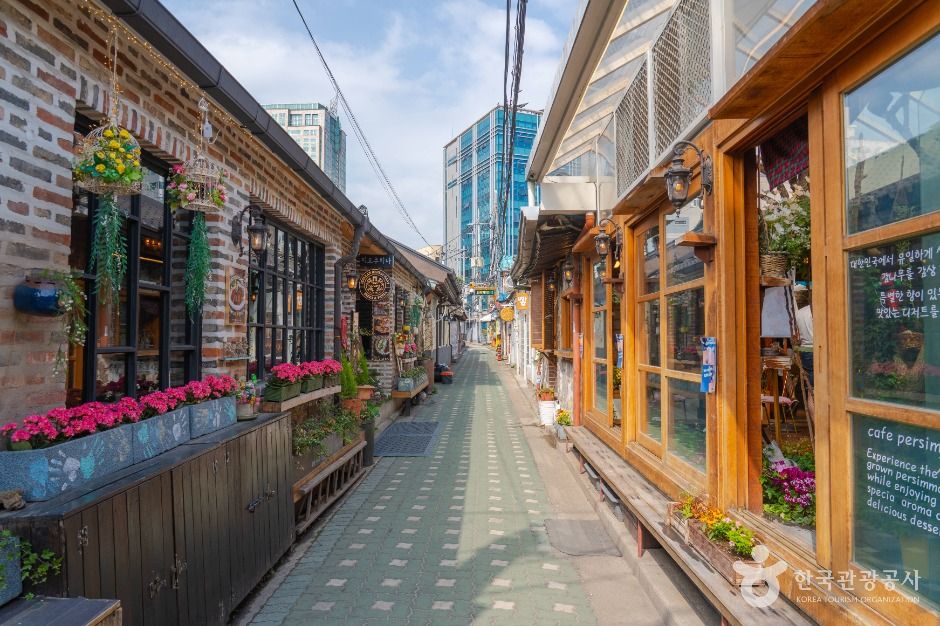
Ikseon-dong Hanok Street (익선동 한옥거리)
9.0Km 2025-10-27
Ikseon-dong, Jongno-gu, Seoul
Ikseon-dong is a place where the harmony of alleys and hanok houses exudes beautiful charm and is a must-visit spot for tourists of all ages and genders. It is also an area that connects the younger and older generations.
![Aritaum - Kyung Hee Univ. Branch [Tax Refund Shop] (아리따움 경희대)](http://tong.visitkorea.or.kr/cms/resource/05/2889605_image2_1.jpg)
Aritaum - Kyung Hee Univ. Branch [Tax Refund Shop] (아리따움 경희대)
9.0Km 2024-04-18
1F, 22, Kyungheedae-ro, Dongdaemun-gu, Seoul
-
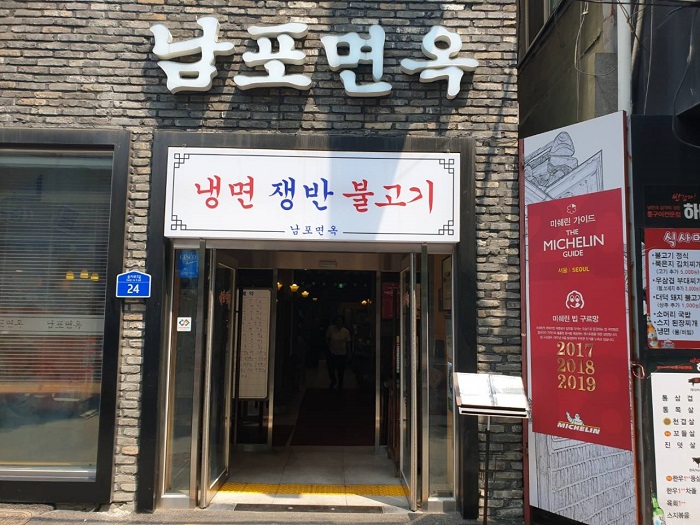
Nampo Myeonok (남포면옥)
9.0Km 2024-03-07
24, Eulji-ro 3-gil, Jung-gu, Seoul
+82-2-777-3131
Located near Seoul City Hall and Cheonggyecheon Stream, Nampo Myeonok is a traditional Korean restaurant. Opened in 1968, it has been recognized by the Michelin Guide several times. Their specialty is pyeongyang naengmyeon (pyeongyang cold buckwheat noodles). The restaurant also serves a variety of other dishes that are the most commonly found in Korea, including galbi tang (galbi soup), bulgogi, mandu soup, and yukgaejang (spicy beef soup).

![Alive Museum (Insa-dong Branch) [박물관은 살아있다(인사동점)]](http://tong.visitkorea.or.kr/cms/resource/27/3109227_image2_1.JPG)
Alive Museum (Insa-dong Branch) [박물관은 살아있다(인사동점)]
9.0Km 2024-03-15
(B1 and B2, Daeil Building), 12, Insadong-gil, Jongno-gu, Seoul
+82-2-1544-8506
The Alive Museum is a media theme park located in Insa-dong. The exhibition here is made up of optical illusion art, large objet, and digital media pieces, which allow you to delve into the land of mystery. It is made up of different sections like the Insadong Photo Studio, Game Village, and the Toy Village.
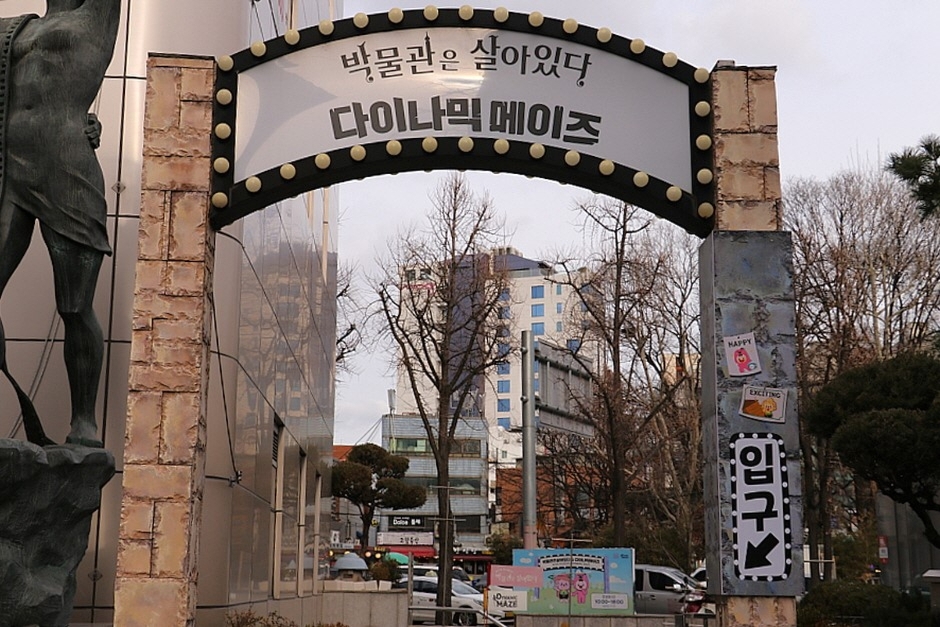
Dynamic Maze (Insa-dong) (다이나믹 메이즈 (서울 인사동점))
9.0Km 2024-03-15
12, Insadong-gil, Jongno-gu, Seoul
+82-1544-8506
Dynamic Maze is an indoor space in Insa-dong dedicated to an exciting adventure: A maze filled with obstacles, requiring participants to work together and overcome the barriers through quickness and focus. Go through the hall of mirrors, climb the wall, and cross the suspension bridge to finally escape from the maze.
Seoul Hyochang Park (서울 효창공원)
9.0Km 2024-07-09
177-18 Hyochangwon-ro, Yongsan-gu, Seoul
+82-2-2199-7608
Hyochang Park covers 122,245 square meters spanning across Hyochang-dong and Cheongpa 2-dong. It is a historic landmark that once contained several royal tombs, and was known at that time as Hyochangwon. The cemeteries that were originally located in Hyochangwon belonged to Crown Prince Munhyo, King Jeongjo’s first son who died at the age of five; Royal Noble Consort Uibin of the Seong Clan, King Jeongjo’s royal concubine and Crown Prince Munhyo’s mother; Royal Noble Consort Sugui of the Park Clan, King Sunjo’s royal concubine; and her daughter Princess Yeongon. The royal tombs were moved to Seooreung Tombs in the waning months of the Japanese colonial period. The Japanese empire began the development of Hyochangwon into a park in 1924, and the Japanese governor-general officially assigned the site as a park in 1940.
Presently, several of Korea’s greatest leaders are buried in Hyochang Park. The remains mostly belong to independence activists including Yoon Bong-gil, Lee Bong-chang, and Baek Jeong-gi, whose graves are collectively known as Samuisa Tomb. A statue of Lee Bong-chang has been built in the graveyard. Among the other patriotic martyrs who are interred in the park are Kim Gu and some of the key figures of the provisional government such as Lee Dong-nyeong, Cha I-seok, and Cho Seong-hwan. An ancestral shrine named Uiyeolsa has been built along the main gate and holds the portraits of the deceased independence activists.
![Insa Chilgi - Insa Branch [Tax Refund Shop] (인사칠기 인사)](http://tong.visitkorea.or.kr/cms/resource/18/2878218_image2_1.jpg)
Insa Chilgi - Insa Branch [Tax Refund Shop] (인사칠기 인사)
9.0Km 2024-04-22
5, Seolleung-ro 162-gil, Gangnam-gu, Seoul
-
 English
 한국어
한국어 日本語
日本語 中文(简体)
 Deutsch
 Français
 Español
 Русский


