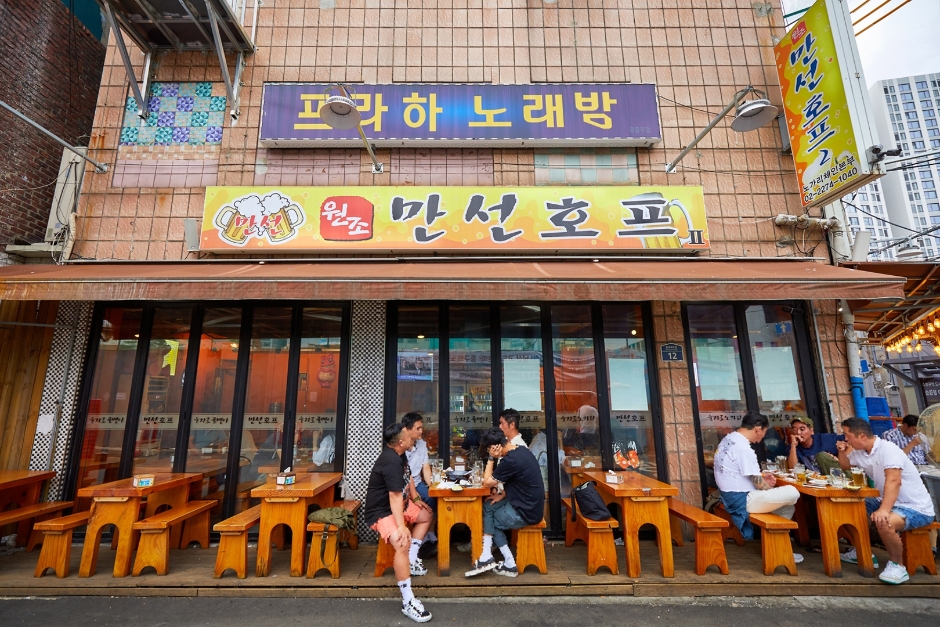
Euljiro Nogari Alley (을지로 노가리골목)
3.5Km 2025-11-06
Eulji-ro 129, Jung-gu, Seoul
Going out of Exit 3 of Euljiro 3-ga Station on Seoul Metro Line 3 and turning to the alley, you will find many pubs selling Nogari/Dried Young Pollack (Korean people grill and dip it in red pepper paste to eat as a side dish with alcohol) and restaurants specializing in Golbaengi/Sea Snails (It is a kind of conch shell, and Korea people made it a seasoned dish and enjoy it with Somyeon/Thin Noodles or use it as a bar sack). People gather in small groups at every outdoor table and sit in every alley to enjoy beer and snacks on weekday evenings and weekends, so it isn't easy to find a seat.
Originally, this area was lined with various company buildings and shops selling tools. However, in 1980, the pub 'Eulji OB Bear' opened, and as similar pubs opened nearby, it naturally came to be called 'Euljiro Nogari Alley.' As the affordable prices of snacks and beer attracted nearby office workers and college students, it has become increasingly popular, leading to its current status.
Here, along with a cold draft beer, let's try the K-snacks only available in Korea, such as Nogari/Dried Young Pollack and Golbaengi/Sea Snails. In addition, snacks such as chicken and fried dishes are also available, so try various snacks.

Jeongdong Observatory (정동전망대)
3.5Km 2022-08-11
15, Deoksugung-gil, Jung-gu, Seoul
Jeongdong Observatory is located on the 13th floor of Seoul City Hall Seosomun building. The observatory has a cafe inside where visitors can enjoy a drink while gazing upon the magnificent view of Deoksugung Palace from above. In addition, the walls of the cafe are decorated with photos of old Jeongdong.
Ebookers Korea Inc. ((주)이부커스코리아)
3.6Km 2025-10-23
(2nd Floor), 212 Jangchungdan-ro, Jung-gu, Seoul
We strive for a special kind of tourism that combines wellness tourism (healing) and medical tourism (treatment).
We are a Korean wellness and medical tourism company leading the country’s safe and healthy travel culture.
* Products and Services
Wellness medical tourism programs that uniquely combine wellness and medical tourism
Referral and reservation service for selected wellness destinations and Korean hospitals with excellent medical technology
Guidance services provided at local partner companies
Content creation and reservation based on our personalized service system
Convenient tourism programs catering to each patient's health conditions
Medical tourism visa application and referral services on C33VISA site
* A medical tourism product brand
Medi Well Come products: Health checkup / general practice (minor / major / female / preventive / eye problems)
The 3.0 Clinic (더3.0피부과의원)
3.6Km 2025-10-23
(4th Floor, Cham Building, Sinsa-dong), 48 Apgujeong-ro 28-gil, Gangnam-gu, Seoul
The 3.0 Clinic has successfully developed a method to treat acne without using conventional acne dermatological treatments that have inevitably accompanying side effects, which require taking cumbersome medications with side effects, and require continuous management. We were invited to give a lecture at the American Academy of Dermatology and also gave lectures in China and Europe. We also developed a simple injection method to reduce sebum, which had no proper treatment. In addition, we developed a method to blur the shape of intractable scars and received an award at the Eastern Asia Dermatology Congress in Japan.
Our skin and body have incredible power. If you understand the reasons why our skin is like this, what changes, and results and take fundamental care of your skin, you can treat acne without taking medicine and atopic dermatitis without steroids.
Symptom relief for the 1.0 generation, fundamental cause and resolution for the 2.0 generation, and prevention for the 3.0 generation. We aim to help people improve the power of their skin!
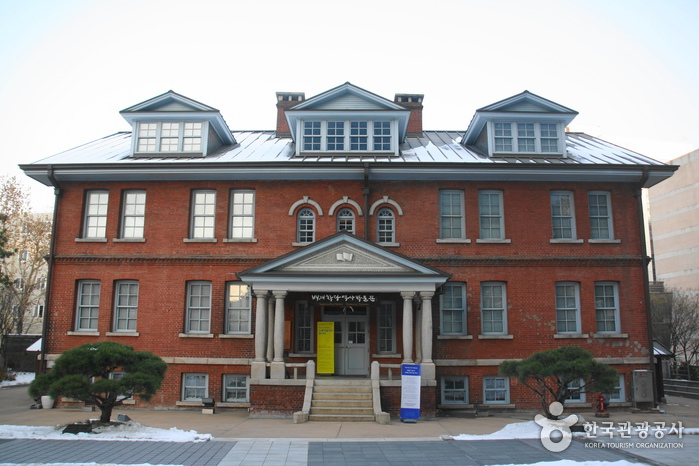
Appenzeller Noble Memorial Museum (배재학당 역사 박물관)
3.6Km 2022-10-14
19, Seosomun-ro 11-gil, Jung-gu, Seoul
The Appenzeller Noble Memorial Museum is dedicated to Henry Gerhart Appenzeller, the missionary who opened the first Western-style educational institution in Korea in 1885. The school started with English and core subjects, but expanded into the Pai Chai University, Pai Chai High School, and Pai Chai Middle School and has many famous alumni, including Rhee Syng-man. The memorial hall opened in 2008 in the east wing of the original school building, which was built in 1916 and designated as a Seoul Monument. With dynamically arranged permanent exhibitions, annual special exhibitions and special lectures, the museum offers a unique learning experience to visitors and people with an interest in the history of education in Korea.
Glovi Plastic Surgery (글로비성형외과의원)
3.6Km 2025-10-23
(6th Floor, EGI Building), 843 Nonhyeon-ro, Gangnam-gu, Seoul
"Glovi Plastic Surgery strives to understand the hearts of our clients."
While standards of beauty have varied across eras and individuals, true beauty remains timeless. At Glovi Plastic Surgery, we are dedicated to discovering and delivering enduring beauty by continuously researching and refining our techniques to ensure the highest level of satisfaction for each patient.
With extensive experience and exceptional technical expertise, Glovi Plastic Surgery offers personalized cosmetic surgery programs tailored to individual characteristics. Our dedicated stem cell research lab, certified by the Ministry of Science, ICT and Future Planning as an R&D department, showcases our differentiated technological capabilities. Additionally, we provide customer satisfaction programs that prioritize patient safety and convenience.
Glovi Plastic Surgery's commitment to rewarding your choice with beauty and confidence continues every day.
Grand Plastic Surgery (그랜드성형외과의원)
3.6Km 2025-10-23
(#601, 6th Floor, JB Miso Building), 841 Nonhyeon-ro, Gangnam-gu, Seoul
With top-notch multidisciplinary medical staff
and a one-stop total healthcare system,
we lead the world in aesthetic medicine.
Grand Plastic Surgery opened its doors in 2004.
In its 19-year history, we established ourselves as Korea's leading aesthetic medicine group.
We are the hospital of choice for more than 30,000 international patients, attracting patients from more than 100 countries around the world with a top-tier specialized medical consultation system, a well-organized safety system, and distinguished services tailored to both domestic and international patients.
Grand Plastic Surgery promises satisfactory surgical results to our patients with our long-standing surgical experience and know-how, and aims to become a medical group capable of leading not only Korea but also Asia and the world.
ID Hospital (아이디병원)
3.6Km 2025-10-23
142 Dosan-daero, Gangnam-gu, Seoul
ID Hospital offers innovative medical services and one-stop solutions, delivering value that is more than just beauty. A plastic surgery clinic comparable to a large hospital, ID Hospital ensures safe, personalized treatments with cutting-edge technology and world-class expertise.
From facial contouring to Mommy Makeover, the clinic creates harmonious transformations that enhance patient's natural beauty and confidence.
ID Clinic (Sinsa Branch) (아이디의원(신사점))
3.6Km 2025-10-23
6F, 142 Dosan-daero, Gangnam-gu, Seoul
ID Cosmedical Group, consisting of ID Plastic Surgery and ID Dermatology, has launched a beauty clinic brand with a new concept that combines its extensive expertise and experience.
Based on its high-quality medical services, ID Clinic offers personalized beauty solutions with exceptional convenience at reasonable costs.
Seoul Museum of Art (서울시립미술관(서소문본관))
3.6Km 2024-06-19
61 Deoksugung-gil, Jung-gu, Seoul
The Seoul Museum of Art (SeMA) is a space for all to meet and experience the joy of art. Located in the center of Jeong-dong, a district that retains traces of Seoul’s modern and contemporary history, the museum integrates the historical facade of the former Supreme Court with modern architecture. In addition to various programs―encompassing exhibitions, educational outreach initiatives, screenings, workshops, performances, and talks, communal spaces including SeMA Cafe, the artbook store, the open space lobby, and the outdoor sculpture park SeMA WALK provide a rich range of ways for visitors to experience art.
 English
 한국어
한국어 日本語
日本語 中文(简体)
 Deutsch
 Français
 Español
 Русский


