
Tonymoly - Dongdaemun Branch [Tax Refund Shop] (토니모리 동대문)
6.5Km 2024-04-18
257, Jangchungdan-ro, Jung-gu, Seoul
-
![CAPO FOOTBALL STORE[Korea Quality]/카포 풋볼 스토어[한국관광 품질인증]](http://tong.visitkorea.or.kr/cms/resource/88/2591988_image2_1.jpg)
CAPO FOOTBALL STORE[Korea Quality]/카포 풋볼 스토어[한국관광 품질인증]
6.5Km 2024-08-20
282 , Eulji-ro, Jung-gu, Seoul
+82-10-8922-7981
Located in Eulji-ro, Jung-gu, Seoul, Capo Football store is the largest football store in Korea. It stocks football boots of various levels, plus fan wear, uniforms, and training wear. On the 5th floor, a customer lounge provides free coffee, a football book cafe, a PlayStation for enjoying FIFA games, table soccer, and an exhibition of capo collections.
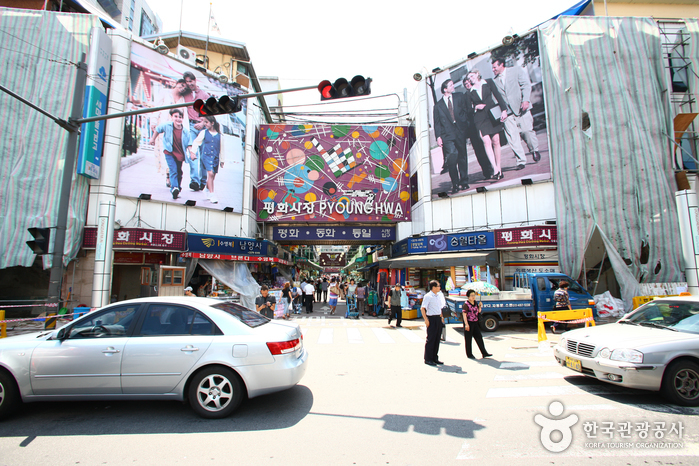
Pyounghwa (Pyeonghwa) Fashion Town (서울 평화시장)
6.5Km 2025-01-06
274, Cheonggyecheon-ro, Jung-gu, Seoul
+82-2-2265-3531~3
The Pyounghwa Fashion Town market in Dongdaemun has been selling fashion clothing and accessories for over 50 years ever since the end of the Korean War. It was here that in 1953 North Korean refugees started selling clothes made from US army uniforms. Their market was then named Pyounghwa, which means peace, in the hope that no other wars would be fought on Korean soil. The Pyounghwa Fashion Town was therefore the beginning of the 30,000 stores that now make up Dongdaemun Fashion Town, which is seen as one of the global centers of the fashion industry.
Spread over a large area, this historical fashion market is divided into several districts, the ‘Gu Pyounghwa Fashion Town’ is the oldest, and there is also the ‘Shin Pyounghwa Fashion Town’, ‘Dong Pyounghwa Fashion Town’, and ‘Cheong Pyounghwa Fashion Town’.
Olive Young - Jeungmi Station Branch [Tax Refund Shop] (올리브영 증미역)
6.5Km 2024-04-17
1F Woorim Blue Nine Service Center, 583, Yangcheon-ro, Gangseo-gu, Seoul
-
![Olive Young - Sindorim Branch [Tax Refund Shop] (올리브영 신도림)](http://tong.visitkorea.or.kr/cms/resource/51/2880151_image2_1.jpg)
Olive Young - Sindorim Branch [Tax Refund Shop] (올리브영 신도림)
6.5Km 2024-04-18
#109, 661, Gyeongin-ro, Guro-gu, Seoul
-
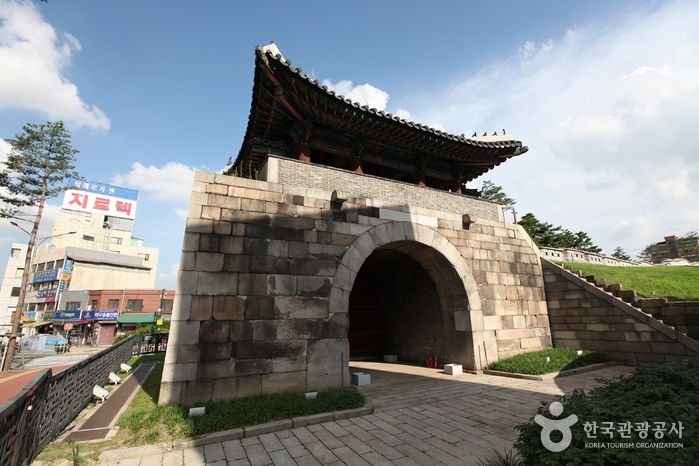
Gwanghuimun Gate (광희문)
6.5Km 2021-02-24
344, Toegye-ro, Jung-gu, Seoul
+82-2-3700-3900
Gwanghuimun Gate is said to have been originally constructed in 1396, the 5th year of King Taejo, at the southeast of the capital city. It was often referred to as Sugumun Gate (water channel gate) and was actually used as a Sigumun, literally meaning “corpse gate,” as funeral processions passed through this gate when exiting to the east.
During the Imjin War (1592-1598), the fortress gate was destroyed to such a degree that it made finding the original location close to impossible. Nevertheless, reconstruction efforts were started in 1711 (37th year of King Sukjong) and the gate was restored together with the gate's watchtower. Gwanghuimun Gate remained intact even when the fortress walls were demolished to build tram tracks during the Japanese occupation, but it was later damaged during the Korean War and left neglected. In 1975, restoration work was carried out to relocate Gwanghuimun Gate to a site 15 meters south of its original location since it stood in the middle of the road.
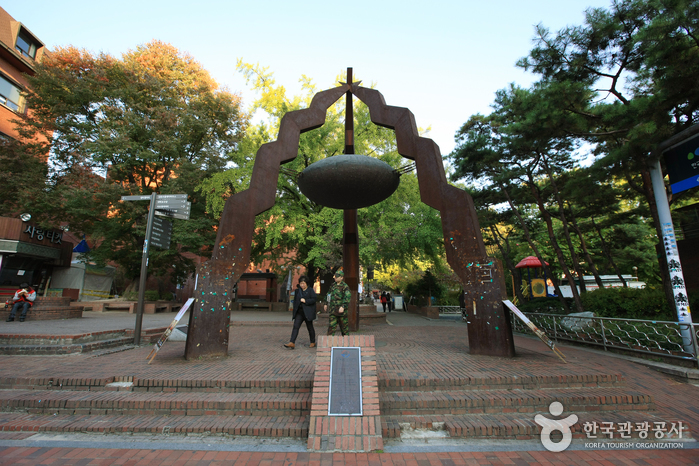
Marronnier Park (마로니에공원)
6.5Km 2021-07-14
104, Daehak-ro, Jongno-gu, Seoul
+82-2-2148-4158
Marronnier Park was given its name due to the marronnier trees, or horse chestnut trees, growing within the area. The location where Seoul National University's College of Liberal Arts & Science and School of Law once stood, it is now a park dedicated to culture and arts open to the public. In addition to a variety of outdoor performances that take place throughout the area, exhibitions and cultural centers create a romantic atmosphere unique to the park.
Artbox - Daehangno Branch [Tax Refund Shop] (아트박스 대학로)
6.5Km 2024-04-22
22, Daemyeong-gil, Jongno-gu, Seoul
-
Seoul National Cemetery (국립서울현충원)
6.5Km 2024-03-07
210, Hyeonchung-ro, Dongjak-gu, Seoul
+82-2-813-9625
Seoul National Cemetery is a national cemetery for individuals who worked or fought for Korea and sacrificed their lives. It encompasses those who fought for Korea's independence from the late 19th century to the early 20th century, those who perished in the Korean War (1950-1953), and former presidents, totaling over 165,000 individuals. There are exhibition halls and parks with related artifacts. Shuttle buses are provided for the convenience of visitors.
![LG Best Shop - Bulgwang Main Branch [Tax Refund Shop] (엘지베스트샵 불광 본점)](http://tong.visitkorea.or.kr/cms/resource/77/2890377_image2_1.jpg)
LG Best Shop - Bulgwang Main Branch [Tax Refund Shop] (엘지베스트샵 불광 본점)
6.5Km 2024-04-18
41, Bulgwang-ro, Eunpyeong-gu, Seoul
-
 English
 한국어
한국어 日本語
日本語 中文(简体)
 Deutsch
 Français
 Español
 Русский


