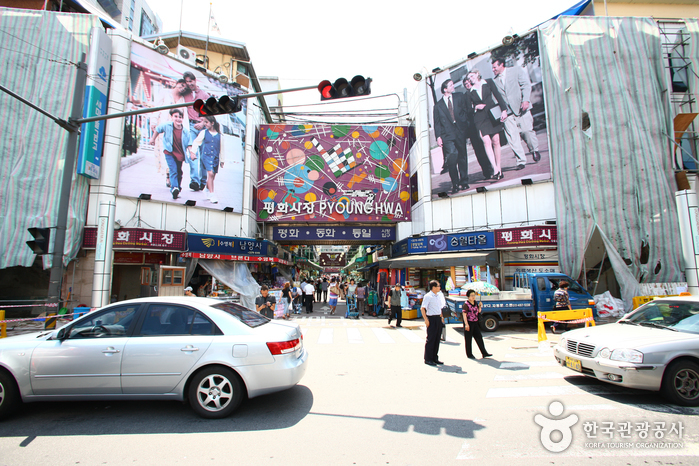
Pyounghwa (Pyeonghwa) Fashion Town (서울 평화시장)
7.0Km 2025-01-06
274, Cheonggyecheon-ro, Jung-gu, Seoul
+82-2-2265-3531~3
The Pyounghwa Fashion Town market in Dongdaemun has been selling fashion clothing and accessories for over 50 years ever since the end of the Korean War. It was here that in 1953 North Korean refugees started selling clothes made from US army uniforms. Their market was then named Pyounghwa, which means peace, in the hope that no other wars would be fought on Korean soil. The Pyounghwa Fashion Town was therefore the beginning of the 30,000 stores that now make up Dongdaemun Fashion Town, which is seen as one of the global centers of the fashion industry.
Spread over a large area, this historical fashion market is divided into several districts, the ‘Gu Pyounghwa Fashion Town’ is the oldest, and there is also the ‘Shin Pyounghwa Fashion Town’, ‘Dong Pyounghwa Fashion Town’, and ‘Cheong Pyounghwa Fashion Town’.
![Olive Young - Suncheonhyang Branch [Tax Refund Shop] (올리브영 순천향입구)](http://tong.visitkorea.or.kr/cms/resource/21/2889221_image2_1.jpg)
Olive Young - Suncheonhyang Branch [Tax Refund Shop] (올리브영 순천향입구)
7.0Km 2024-04-16
71, Daesagwan-ro, Yongsan-gu, Seoul
-

Olive Young - Hyehwa Station Branch [Tax Refund Shop] (올리브영 혜화역점)
7.0Km 2024-06-27
1F, 122, Daehak-ro, Jongno-gu, Seoul
-
![CAPO FOOTBALL STORE[Korea Quality]/카포 풋볼 스토어[한국관광 품질인증]](http://tong.visitkorea.or.kr/cms/resource/88/2591988_image2_1.jpg)
CAPO FOOTBALL STORE[Korea Quality]/카포 풋볼 스토어[한국관광 품질인증]
7.0Km 2024-08-20
282 , Eulji-ro, Jung-gu, Seoul
+82-10-8922-7981
Located in Eulji-ro, Jung-gu, Seoul, Capo Football store is the largest football store in Korea. It stocks football boots of various levels, plus fan wear, uniforms, and training wear. On the 5th floor, a customer lounge provides free coffee, a football book cafe, a PlayStation for enjoying FIFA games, table soccer, and an exhibition of capo collections.
Olive Young - Boramae Branch [Tax Refund Shop] (올리브영 보라매)
7.0Km 2024-04-18
16, Boramae-ro 5ga-gil, Dongjak-gu, Seoul
-
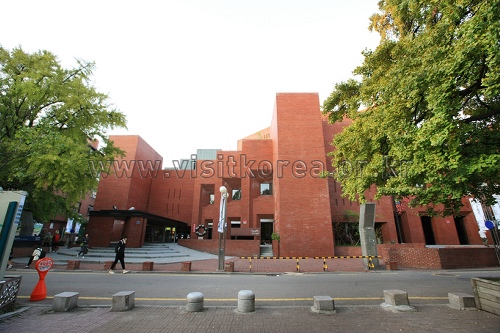
Arko Arts Theater (아르코예술극장)
7.0Km 2021-04-16
7, Daehak-ro 8-gil, Jongno-gu, Seoul
+82-2-3668-0007
Opened on April 1, 1981, Arko Arts Theater’s mission statement is to “boost performance art, obtain performance space to promote its popularity among the public, and support stages to pure art organizations facing financial difficulties." As the center of performance art, the theater also began to attract a slew of small theaters and has played a pivotal role in promoting performance art and populating Dongsung-dong with artists. The theater offers a large hall, small hall, multipurpose studio space, and practice room.
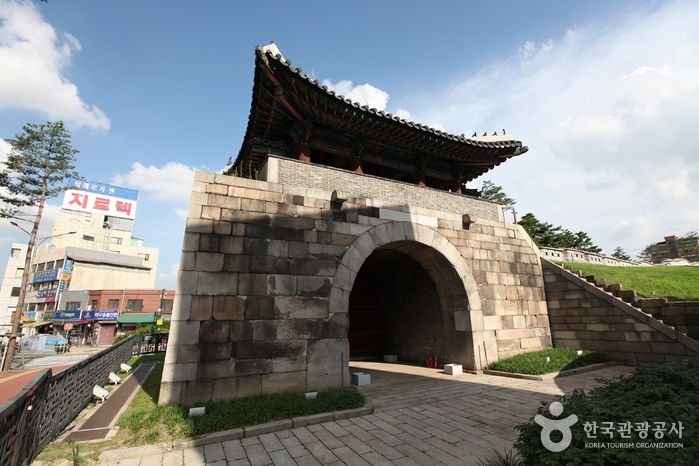
Gwanghuimun Gate (광희문)
7.0Km 2021-02-24
344, Toegye-ro, Jung-gu, Seoul
+82-2-3700-3900
Gwanghuimun Gate is said to have been originally constructed in 1396, the 5th year of King Taejo, at the southeast of the capital city. It was often referred to as Sugumun Gate (water channel gate) and was actually used as a Sigumun, literally meaning “corpse gate,” as funeral processions passed through this gate when exiting to the east.
During the Imjin War (1592-1598), the fortress gate was destroyed to such a degree that it made finding the original location close to impossible. Nevertheless, reconstruction efforts were started in 1711 (37th year of King Sukjong) and the gate was restored together with the gate's watchtower. Gwanghuimun Gate remained intact even when the fortress walls were demolished to build tram tracks during the Japanese occupation, but it was later damaged during the Korean War and left neglected. In 1975, restoration work was carried out to relocate Gwanghuimun Gate to a site 15 meters south of its original location since it stood in the middle of the road.
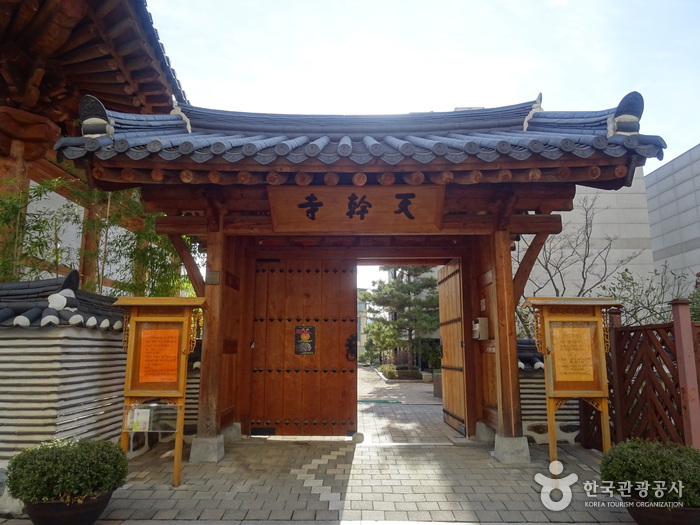
Cheongansa Temple (천간사)
7.0Km 2021-10-12
20-8, Bulgwang-ro 10-gil, Eunpyeong-gu, Seoul
+82-2-355-7430
Cheongansa Temple was first built in 1960, and was re-built in 2009. It has many pagodas and monuments: a pagoda filled with sari relics of Buddha; Budotap Pagoda, which is a shrine to the monk who found the temple and his sacred relics; and a monument honoring the late first lady Yuk yeong-su. The re-built temple was awarded the Hanok Prize in the Hanok Competition 2011. Located along the Bukhansan Mt. Dulaegil Trail, the temple provide visitors with the chance to enjoy fresh air and a rest from hiking along the trail.
 English
 한국어
한국어 日本語
日本語 中文(简体)
 Deutsch
 Français
 Español
 Русский


