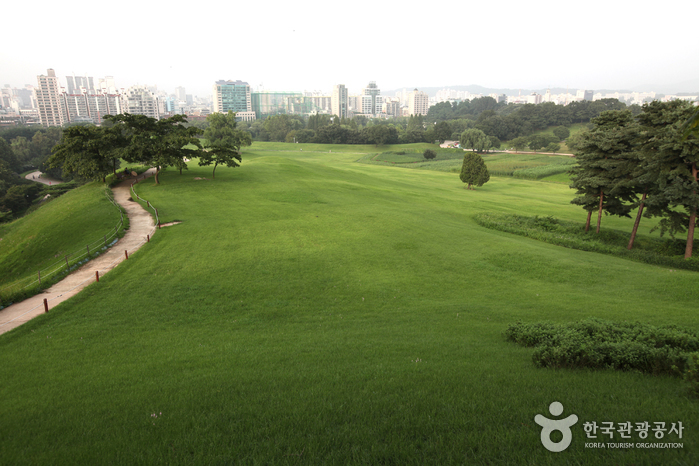
Seoul Mongchontoseong Earthen Fortification (서울 몽촌토성)
18.0Km 2024-03-12
424, Olympic-ro, Songpa-gu, Seoul
+82-2-2147-2814
Mongchontoseong Earthen Fortification is an ancient earthen fortress built during the Hanseong period of the ancient Korean kingdom of Baekje (BC 18-AD 660). It is believed to have been constructed in the 3rd to 4th centuries. Utilizing the natural advantages of the Hangang River, it served defensive purposes with its trench and log barrier. Excavated relics from the Baekje era are on display at the Seoul Baekje Museum. The site is situated within the Olympic Park in Songpa, Seoul.
![Olive Young - Cheonho Jungang Branch [Tax Refund Shop] (올리브영 천호중앙)](http://tong.visitkorea.or.kr/cms/resource/76/2878876_image2_1.jpg)
Olive Young - Cheonho Jungang Branch [Tax Refund Shop] (올리브영 천호중앙)
18.0Km 2024-04-18
1027, Cheonho-daero, Gangdong-gu, Seoul
-
![Muji - Lotte Ilsan Branch [Tax Refund Shop] (MUJI 롯데일산)](http://tong.visitkorea.or.kr/cms/resource/03/2888103_image2_1.jpg)
Muji - Lotte Ilsan Branch [Tax Refund Shop] (MUJI 롯데일산)
18.0Km 2024-04-19
B1, 1283, Jungang-ro, Ilsandong-gu, Goyang-si, Gyeonggi-do
-
![Golden Dew - Lotte Ilsan Branch [Tax Refund Shop] (골든듀 롯데일산)](http://tong.visitkorea.or.kr/cms/resource/98/2880698_image2_1.jpg)
Golden Dew - Lotte Ilsan Branch [Tax Refund Shop] (골든듀 롯데일산)
18.0Km 2024-04-19
1F, Golden Dew, 1283, Jungang-ro, Ilsandong-gu, Goyang-si, Gyeonggi-do
-
![Elord [Tax Refund Shop] (엘로드)](http://tong.visitkorea.or.kr/cms/resource/89/2890789_image2_1.jpg)
Elord [Tax Refund Shop] (엘로드)
18.0Km 2024-04-23
1283, Jungang-ro, Ilsandong-gu, Goyang-si, Gyeonggi-do
-
![Daks Golf [Tax Refund Shop] (닥스골프)](http://tong.visitkorea.or.kr/cms/resource/91/2890791_image2_1.jpg)
Daks Golf [Tax Refund Shop] (닥스골프)
18.0Km 2024-04-19
7F, 1283, Jungang-ro, Ilsandong-gu, Goyang-si, Gyeonggi-do
-
![Sisley [Tax Refund Shop] (시슬리)](http://tong.visitkorea.or.kr/cms/resource/95/2890795_image2_1.jpg)
Sisley [Tax Refund Shop] (시슬리)
18.0Km 2024-04-22
1283, Jungang-ro, Ilsandong-gu, Goyang-si, Gyeonggi-do
-
![LOTTE Department Store - Ilsan Store [Tax Refund Shop] (롯데백화점 일산점)](http://tong.visitkorea.or.kr/cms/resource/04/3007904_image2_1.jpg)
LOTTE Department Store - Ilsan Store [Tax Refund Shop] (롯데백화점 일산점)
18.0Km 2024-04-23
8F, 1283, Jungang-ro, Ilsandong-gu, Goyang-si, Gyeonggi-do
- As the first department store in Ilsan, LOTTE Department Store Ilsan presents a continuous stream of fresh and delightful encounters each day with its various community facilities, from its shopping mall, cultural hall, and gallery. As a symbol of Ilsan, LOTTE Department Store Ilsan goes beyond shopping, providing an abundance of cultural and experiential spaces.
Elevate your shopping experience at LOTTE Department Store Ilsan, seamlessly connected to the subway and equipped with a large parking facility.
![ABC-Mart - Cheonho Branch [Tax Refund Shop] (ABC마트 천호점)](http://tong.visitkorea.or.kr/cms/resource/79/2878879_image2_1.jpg)
ABC-Mart - Cheonho Branch [Tax Refund Shop] (ABC마트 천호점)
18.0Km 2024-04-18
7, Cheonho-daero 157-gil, Gangdong-gu, Seoul
-
![Ekonomy Hotel Bupyeong [Korea Quality] / 이코노미호텔 인천부평점 [한국관광 품질인증]](http://tong.visitkorea.or.kr/cms/resource/75/2765975_image2_1.jpg)
Ekonomy Hotel Bupyeong [Korea Quality] / 이코노미호텔 인천부평점 [한국관광 품질인증]
18.1Km 2023-05-02
88-6 , Bupyeong-daero 296beon-gil, Bupyeong-gu, Incheon
+82-32-529-4941
The Ekonomy Hotel Bupyeong in Incheon is an inexpensive but friendly, clean and comfortable hotel for women, family and business travelers. It has excellent transport access, as it’s just a 5-minute walk from Galsan Station on the Incheon Subway. Free breakfast is provided, and there’s a table tennis court, movie theater, fitness center and business center in the basement. Sunset and night views from the rooftop garden are outstanding. Nearby tourist attractions include Incheon’s Chinatown, Yeonan Pier, Wolmido Island, and Ganghwado Island.
 English
 한국어
한국어 日本語
日本語 中文(简体)
 Deutsch
 Français
 Español
 Русский


