![Olens - Myeong-dong Embassy Branch [Tax Refund Shop] (오렌즈 명동대사관점)](http://tong.visitkorea.or.kr/cms/resource/05/2878605_image2_1.jpg)
Olens - Myeong-dong Embassy Branch [Tax Refund Shop] (오렌즈 명동대사관점)
12.8Km 2024-04-22
50, Myeongdong 2-gil, Jung-gu, Seoul
-
![Zen - Myeong-dong Branch [Tax Refund Shop] (ZEN 명동)](http://tong.visitkorea.or.kr/cms/resource/63/2888763_image2_1.jpg)
Zen - Myeong-dong Branch [Tax Refund Shop] (ZEN 명동)
12.8Km 2024-04-16
5-8F, 62, Myeongdong-gil, Jung-gu, Seoul
-

Artbox - Jongno 3(sam)-ga Branch [Tax Refund Shop] (아트박스 종로3가)
12.8Km 2024-04-17
126, Jong-ro, Jongno-gu, Seoul
-
Seoul Doseonsa Temple (도선사(서울))
12.8Km 2025-06-25
504 Samyang-ro 173-gil, Gangbuk-gu, Seoul
Doseonsa Temple was established 1,100 years ago during the latter part of the Silla Kingdom when the renowned Buddhist priest Doseonguksa was traveling through the mountains. After visiting the site, Doseonguksa made a prophecy that led to the construction of the temple. According to legend, he used only his walking stick to carve the large Bodhisattva that sits at the temple. Interestingly enough, the statue does not show any evidence of chisel marks, further adding to the mystery of how the statue was made.
During the 7th year of King Gwangmu of the Joseon dynasty, Doseonsa Temple was officially named the representative temple of Korea with the purpose of promoting Cheongdamdaejongsa's Korean Buddhism movement, aiming at a religious revival. Due to these special circumstances Deseonsa Temple gained a high reputation and much recognition, which have held strong to this day.
Inside the temple, visitors can view the remains and written works of Cheongdamdaejongsa in the Cheongdamdaejongsa Memorial Hall. Next to the road leading to Cheonbuljeon Hall is a pond where you can toss a coin and make a wish and just past Yongammun Gate is a hiking path connecting Baegundae Cliff and Insubong Peak. Inside the Ksitigarbha Hall are portraits of President Park Chung-hee, Yuk Yeong-su, and Hyundai Chairman Chung Ju-yung. In front of the hall is a tree that is said to have been planted by a Buddhist priest who brought it from India 200 years ago. Historical artifacts can be found throughout the temple.
![Innisfree - Myeong-dong Chungmu Branch [Tax Refund Shop] (이니스프리 명동충무)](http://tong.visitkorea.or.kr/cms/resource/11/2878611_image2_1.jpg)
Innisfree - Myeong-dong Chungmu Branch [Tax Refund Shop] (이니스프리 명동충무)
12.8Km 2024-04-16
28-1, Myeongdong 8na-gil, Jung-gu, Seoul
-
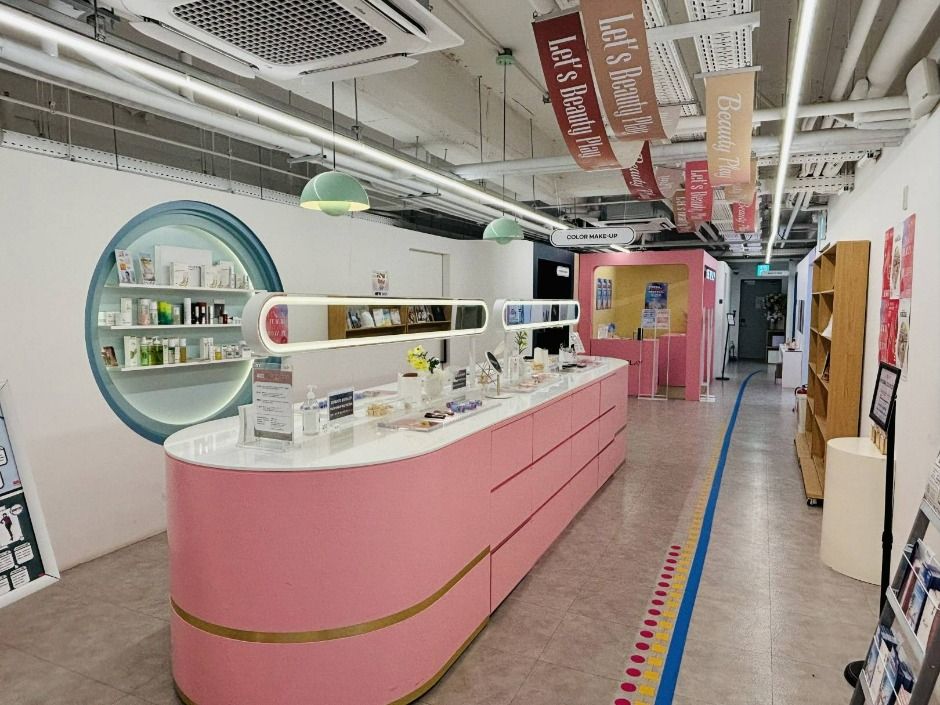
Beauty Play (뷰티플레이)
12.8Km 2025-11-14
73 Myeongdong-gil, Jung-gu, Seoul
Beauty Play is a K-beauty experience center operated by the Korea Cosmetics Industry Institute and supported by the Ministry of Health and Welfare. It offers a wide variety of sample Korean beauty products for testing as well as diverse beauty experience programs such as makeup touch-up service (choice of base, eyes, or lips), personal color test, and skin evaluation. Visitors can also ask for product recommendation based on their skin type or skincare concerns. Beauty Play also frequently hosts free one-day classes, which are announced online via its official website. It also hosts a variety of sample product giveaway events and the exhibited products get changed every two months, allowing visitors to get familiarized with lesser known quality products as well.
![Kaist Optical Shop [Tax Refund Shop] (카이스트안경)](http://tong.visitkorea.or.kr/cms/resource/47/2878647_image2_1.jpg)
Kaist Optical Shop [Tax Refund Shop] (카이스트안경)
12.8Km 2024-04-22
49, Myeongdong 2-gil, Jung-gu, Seoul
-
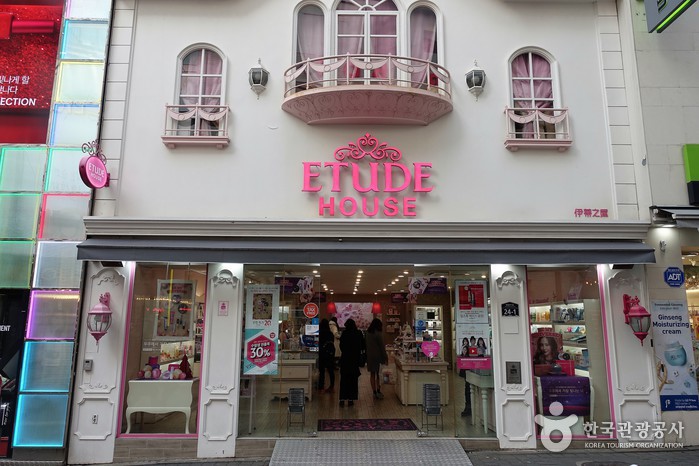
Etude house myeongdong chungmuro / 에뛰드하우스(명동충무로점)
12.8Km 2025-08-11
24-1, Myeongdong 8na-gil, Jung-gu, Seoul
+82-2-777-1704
Etude House is a cosmetics brand that sells makeup, hair, and fragrance products. The Etude House Myeongdong Chungmuro Branch, located in the heart of a major shopping district, carries a wide selection of cosmetics that customers may test before purchasing. Moreover, the brightly lit store interior, designed with a princess bedroom decor, adds fun to the experience.
It is visited largely by foreign customers from Japan, Thailand, China and other East Asian countries. To facilitate an easy shopping experience, the shop always has foreign staff available to assist. The most popular items include creams made using snail extract, lipsticks and eye shadows. Etude House also has many sales on facial mask packs, and tax refunds are available.
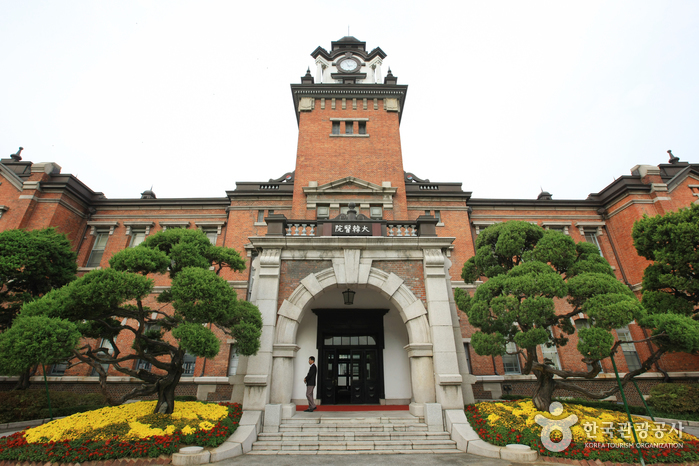
Seoul Daehan Hospital (서울 대한의원)
12.8Km 2021-12-23
101, Daehak-ro, Jongno-gu, Seoul
+82-2-2148-1842
Daehanuiwon (Daehan Medical Center) is an antique two-story brick building within the grounds of Seoul National University Hospital. It was established under the direct administration of the Uijeongbu (State Council), combining the Gwangjewon (under the Home Ministry), Gyeongseong Medical School and the Korean Red Cross Hospital (under the Royal Household).
Built in the Madubong Hill area, this location where Hamchunwon, the outer garden of Changgyeonggung Palace, once stood in 1484 (15th year of King Seongjong), was also once the site of Gyeongmogung Palace, where King Jeongjo enshrined the mortuary tablet of his birth father Crown Prince Sado Seja in 1776 (the year King Jeongjo ascended to the throne).
These places that held importance for the royal family were destroyed as the Japanese built Gyeongseong Empire University in its place. In 1907, with the announcement of the plan to establish Daehan Medical Center, construction began on the main building, seven wards and affiliated buildings. Construction was completed in November 1908.
The Daehan Medical Center opened in Gwangjewon, but upon Japanese colonization in 1910, its name was changed to the Japanese Viceroyalty Hospital. In 1926, it was included as a part of Gyeongseongjeguk University to become a university hospital. Since the liberation of Korea in 1945, it has been a hospital affiliated with Seoul National University.
Happy Jewerly [Tax Refund Shop] (해피쥬얼리)
12.8Km 2024-06-27
1F, #21, 26, Donhwamun-ro, Jongno-gu, Seoul
-
 English
 한국어
한국어 日本語
日本語 中文(简体)
 Deutsch
 Français
 Español
 Русский


