
Jeju Samseonghyeol (제주 삼성혈)
3.6Km 2024-03-13
22 Samseong-ro, Jeju-si, Jeju-do
+82-64-722-3315
Samseonghyeol is a revered site featuring three mythical holes, believed to be the origin of Jeju island's mythical founders: Go, Yang, and Bu. This sacred location is enveloped by ancient trees, standing for centuries, and remarkably, the holes are known to never fill with water, no matter how hard it rains or snows. Adjacent to these remarkable natural phoenomena, visitors will find an exhibition hall and a media gallery dedicated to telling the lore of Samseonghyeol. Additionally, the site is surrounded by historical structures dating back to the Joseon period.
![Angyeong Sarang [Tax Refund Shop] (안경사랑)](http://tong.visitkorea.or.kr/cms/resource/78/2887378_image2_1.jpg)
Iho Tewoo Beach (이호테우해변)
3.6Km 2023-01-13
Dori-ro, Jeju-si, Jeju-do
+82-64-740-6000
Iho Tewoo Beach is conveniently located close to downtown Jeju-si. The sandy, gently sloping beach and its mix of city amenities and natural beauty make it a popular destination for tourists during the summer.
There are plenty of things for visitors to enjoy in the beach area. Visitors can rent boats to go fishing or fish off the seawall, an area known among the local fisherman for its abundance of sea smelts. The beach and the pine forest are especially beautiful at night. There are also many restaurants located nearby to enjoy a great meal with a view of the beach.
![Gwandeokjeong Pavillion (Jeju) [관덕정(제주)]](http://tong.visitkorea.or.kr/cms/resource/75/2513575_image2_1.jpg)
Gwandeokjeong Pavillion (Jeju) [관덕정(제주)]
3.6Km 2024-03-15
19 Gwandeok-ro, Jeju-si, Jeju-do
+82-64-740-6000
One of the oldest buildings in Jeju, Gwandeokjeong Pavilion was established in 1448 by the magistrate of Jeju with the purpose of training local soldiers. This historical edifice is renowend for its intricately painted girders, adorned with murals depicting the ten symbols of longevity, scenes from the Battle of Red Cliffs, and hunting imagery. Additionally, the pavilion's signboard is reputed to feature the handwriting of Prince Anpyeong, a notable figure from the Joseon era. Gwandeokjeong Pavillion is part of the Jeju-mok Government Office complex.
Jeju-mok Government Office (제주목관아)
3.7Km 2024-03-15
25 Gwandeok-ro, Jeju-si, Jeju-do
+82-64-710-6714
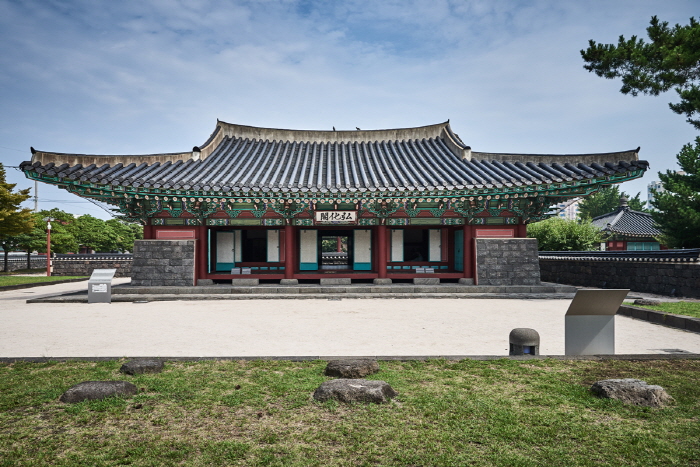
The Jeju-mok Government Office was a gwana, or regional government office, that historically served as the center of Jeju Island’s political, administrative, and cultural activities, spanning from its early days as the State of Tamna through the Joseon period. A significant portion of the structure was destroyed in a fire in 1434, leading to subsequent rebuilding efforts. From 1991, archeological excavations were conducted in four stages, enabling the meticulous restoration of several key buildings within the complex. These include the Honghwagak Pavilion, Yeonhuigak Pavilion, Uyeondang Pavilion, Gyullimdang Pavilion, and Gwandeokjeong Pavillion, all of which were restored by December 2002. Additionally, the complex is known for hosting annual nighttime events.
CU - Iho Tewoo Beach Branch [Tax Refund Shop] (cu이호테우해변점)
3.7Km 2024-06-28
172, Teuhaean-ro, Jeju-si, Jeju-do
-
![Samsonite - Jeju Chilseong Branch [Tax Refund Shop] (쌤소나이트 제주칠성)](http://tong.visitkorea.or.kr/cms/resource/80/2889480_image2_1.jpg)
Samsonite - Jeju Chilseong Branch [Tax Refund Shop] (쌤소나이트 제주칠성)
3.7Km 2024-04-18
#1, 67, Jungang-ro, Jeju-si, Jeju-do
-
![Selden [Tax Refund Shop] (셀덴)](http://tong.visitkorea.or.kr/cms/resource/71/2887371_image2_1.jpg)
![Glass Story & Lens Story - Jungang-ro Branch [Tax Refund Shop] (글라스스토리&렌즈스토리중앙로점)](http://tong.visitkorea.or.kr/cms/resource/97/2887397_image2_1.jpg)
Glass Story & Lens Story - Jungang-ro Branch [Tax Refund Shop] (글라스스토리&렌즈스토리중앙로점)
3.8Km 2024-06-27
63, Jungang-ro, Jeju-si, Jeju-do
-
Dongmun Traditional Market (동문재래시장)
3.8Km 2025-04-01
20 Gwandeok-ro 14-gil, Jeju-si, Jeju-do
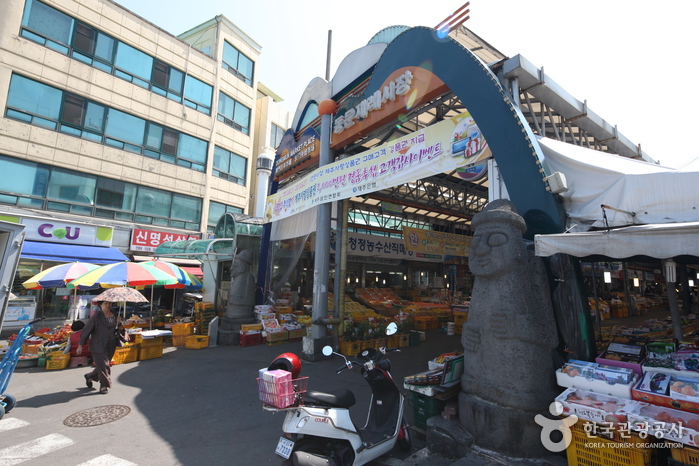
Dongmun Traditional Market, steeped in history, stands a quintessential market of Jeju Island. Together with the adjacent Dongmun Traditional Fish Market, it forms the core of Jeju’s most significant and expansive permanent market, established right after Korea’s liberation in August 1945. Originally the island’s only permanent marketplace and a hub for its commercial activities, the market was relocated to its present site after a devastating fire in March 1954. It offers an array of goods such as vegetables, fruits, seafood, medicinal herbs, grains, and clothing. Known for its fresh catch, the market is a go-to place for seafood lovers, offering delicacies like sliced raw cutlassfish at reasonable prices. It’s also gaining popularity for its innovative dishes, including samhap (skate, pork, and kimchi combo) served with rice and abalone intestines, as well as tteokgalbi (grilled galbi patties) accompanied by whole abalone.
 English
 한국어
한국어 日本語
日本語 中文(简体)
 Deutsch
 Français
 Español
 Русский


